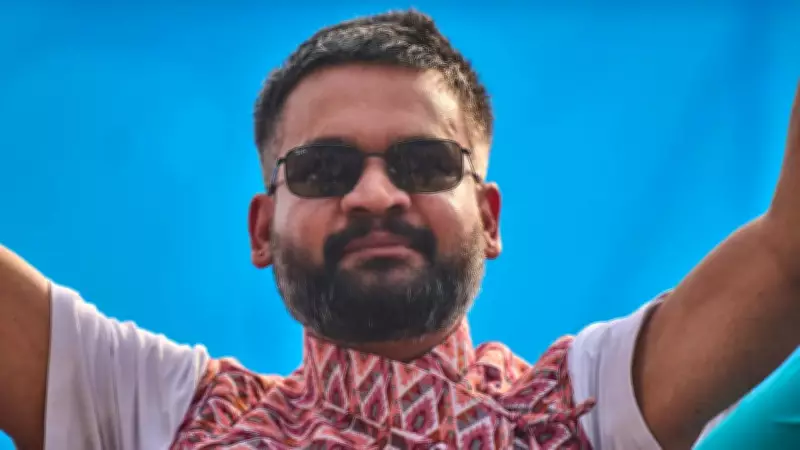
From Rap Battles to Political Battlegrounds: Balen Shah's Unconventional Rise
In the dusty courtyards of Jhapa district, a political phenomenon is unfolding that could reshape Nepal's political landscape. As the country prepares for its March 5 parliamentary elections, former Kathmandu mayor Balendra Shah—known simply as Balen—is drawing unprecedented crowds in his challenge against four-time former prime minister KP Sharma Oli.
The Cult of Personality: Sunglasses and Selfies
On a recent Sunday in Jhapa, supporters formed serpentine queues just for a fleeting moment with their political idol. The scene resembled a celebrity appearance more than a traditional political rally, with volunteers managing the flow to allow barely ten seconds per supporter—a quick handshake, a shared smile, a cherished photograph.
"I am here to see Balen though I have a fever," declared a determined seven-year-old girl, while a middle-aged woman admitted to abandoning a heart check-up midway. "Just for a photo," she explained, capturing the magnetic pull of the 35-year-old politician.

At the center stood Balen in his signature uniform: dark blazer, trimmed beard, and rectangular black sunglasses. This distinctive look has become so iconic that Kathmandu shops once exhausted their stock of the frames he favors, and online retailers continue marketing them as 'Balen Shah glasses.' When he ascends the campaign stage, crowds often mirror his aesthetic in black shirts and dark shades.
A David Versus Goliath Contest
The electoral battle in Jhapa-5 represents a classic political mismatch. On one side stands 74-year-old KP Sharma Oli, the seasoned leader of the Communist Party of Nepal – Unified Marxist Leninist (CPN-UML), whose political networks run deep in this eastern constituency located just 300 kilometers southeast of Kathmandu. The area's proximity to Nepal's open border with India—with Siliguri in West Bengal serving as a crucial commercial gateway—adds strategic importance to the contest.
Opposing this political veteran is Balen Shah, contesting his first national election under the banner of the Rastriya Swatantra Party (RSP), a political entity less than four years old. The 36-year-old faces the formidable challenge of penetrating territory that has historically resisted political outsiders.
From Engineering to Protest Music
Balen's background reveals a journey from technical discipline to political disruption. Born in Kathmandu as the youngest of four siblings, he was described by his late father—a government Ayurveda practitioner—as "bright and simple," a child who wrote poems that evolved into a lifelong habit. After studying civil engineering in Kathmandu and completing postgraduate work in structural engineering in India, Balen seemed destined for a conventional professional path.
Everything changed in 2013 when he entered Raw Barz, Nepal's premier rap battle stage, and emerged victorious. His lyrics proved unsparing in their critique of corruption, political stagnation, and dynastic power structures. "More than a rapper, he was a poet," recalled one organizer. "He talked about suppressed people."
His protest music transcended underground circles, eventually making him the most frequently mentioned figure in online discussions about interim leadership following Oli's resignation. On Discord forums where young activists debated Nepal's future direction, Balen's name surfaced more than 16,000 times, with many Generation Z protesters viewing him as their preferred successor—a role he declined while publicly endorsing former Supreme Court chief justice Sushila Karki instead.
Mayoral Tenure and Political Confrontation
In 2022, running as an independent candidate, Balen achieved a stunning political upset by winning the Kathmandu mayoralty with 61,767 votes, defeating nominees from established political parties. His governance style proved as confrontational as his lyrics, featuring bulldozers demolishing illegal structures and temporary halts to waste collection at Singha Durbar—the complex housing the prime minister's office—in protest against perceived central government inaction.

The political climate intensified dramatically in September 2025 when youth-led protests against unemployment, corruption, and perceived impunity erupted across Nepal. The demonstrations turned violent, with security force crackdowns under Oli's government leaving 77 people dead. Though Balen did not formally lead these protests, he became inextricably linked with their spirit and demands.
In a midnight Facebook post that November, while still serving as Kathmandu mayor, Balen channeled the nation's fury with characteristic bluntness: "F*** America, F*** India, F*** China, F*** UML, F*** Congress, F*** RSP, F*** RPP, F*** Maobaadi. You guys all combined can do nothing." Two months later, he resigned his mayoral position and formally joined the Rastriya Swatantra Party.
The Digital Campaign Strategy
Balen has cultivated a political approach that bypasses traditional media channels. He declined Oli's invitation for a public debate, instead demanding that the former prime minister take responsibility for civilian deaths during the 2025 protests. Instead, he relies almost exclusively on social media platforms where he commands an audience unmatched in Nepali politics: 3.5 million followers on Facebook, 1 million each on Instagram and YouTube, and 400,000 on X (formerly Twitter).
"He speaks the language of our frustration," explained Srijan Karki, a 23-year-old software developer. "Other leaders deliver long speeches. He makes direct statements. Even when he is angry, it feels genuine."
Voter Sentiment and Electoral Implications
The enthusiasm surrounding Balen's candidacy extends beyond his immediate constituency. Aayal Sah, a 23-year-old first-time voter from Janakpur, traveled specifically to hear him speak after he joined RSP. "I cannot directly vote for Balen as he is not contesting from our area," Sah acknowledged. "But I'll surely vote for his party."
In Jhapa's Damak town, 25-year-old Bipana Oli—a migrant worker who returned from Kuwait specifically to cast her ballot—connected her personal future directly to the election outcome. "How long I continue working in Kuwait will depend on Balen's victory," she stated. "And the job opportunities he creates."
As Nepal approaches its March 5 election, the contest in Jhapa-5 symbolizes a broader generational and ideological struggle. A politician who rose to prominence through protest music and social media now challenges one of Nepal's most enduring political figures, testing whether online popularity can translate into electoral success in traditional political strongholds. The outcome will reveal much about the evolving nature of political engagement in contemporary Nepal.