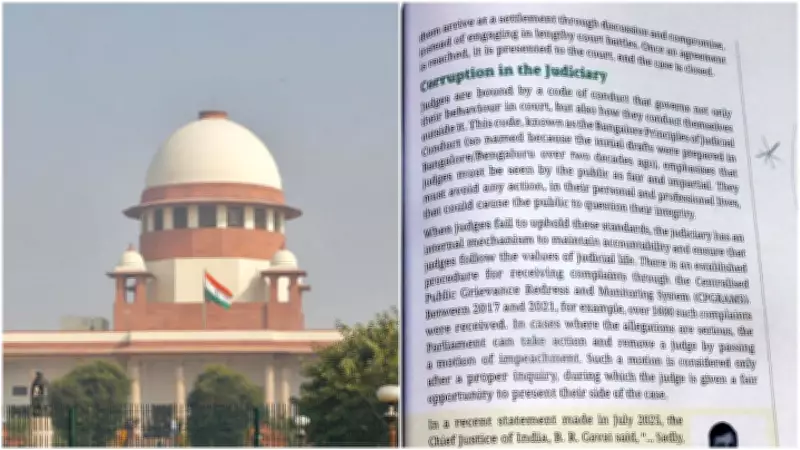
Supreme Court Takes Cognizance of NCERT Chapter on 'Corruption in Judiciary'
The Supreme Court of India has formally taken cognizance of a chapter included in NCERT textbooks that discusses 'corruption in judiciary'. This development has sparked significant attention, with the apex court expressing concerns over the potential defamation of judicial institutions.
Chief Justice Surya Kant's Statement
Chief Justice of India Surya Kant addressed the issue, stating that the inclusion of this chapter appears to be a 'calculated move'. He emphasized his commitment to safeguarding the reputation of the judiciary, saying, 'I won't allow anybody to defame institution'. The Chief Justice added that he would refrain from elaborating further at this time, indicating a cautious approach to the matter.
Background and Implications
The NCERT chapter in question has raised eyebrows for its direct reference to judicial corruption, a topic often considered sensitive within legal and educational circles. The Supreme Court's intervention highlights the ongoing debate over academic freedom versus institutional respect. This move underscores the court's proactive stance in monitoring content that could impact public perception of the judiciary.
Legal experts suggest that this cognizance may lead to a review of the chapter's content, potentially influencing future educational materials. The incident also reflects broader tensions between transparency in governance and the protection of institutional integrity in India.
Public and Legal Reactions
Reactions from the public and legal community have been mixed, with some advocating for open discussions on corruption to promote accountability, while others support the Supreme Court's position to prevent unwarranted criticism. The case is expected to set a precedent for how educational institutions handle sensitive topics related to governance and law.
As the situation unfolds, stakeholders await further developments, including possible hearings or directives from the Supreme Court regarding the NCERT chapter. This event marks a significant moment in the intersection of education, law, and institutional reputation in India.