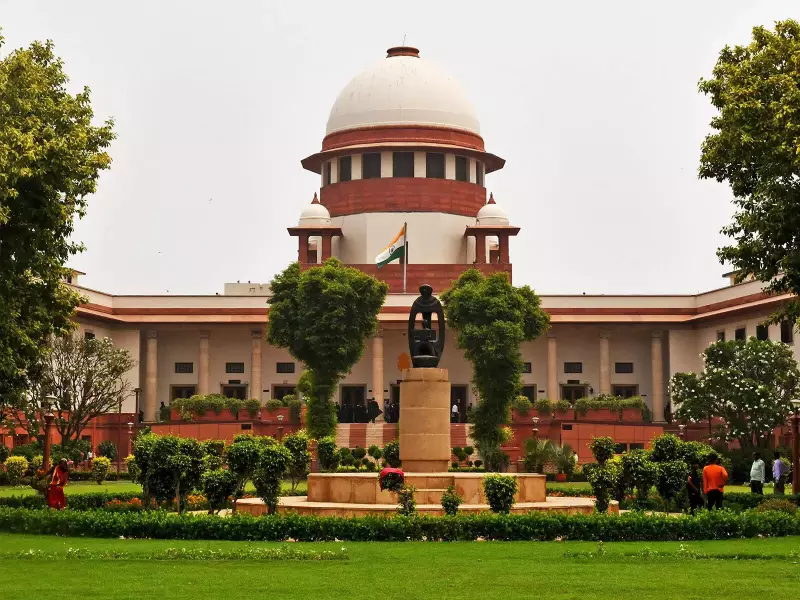
The Supreme Court of India, on Tuesday, issued a firm directive to the counsel for the Association for Democratic Reforms (ADR), Prashant Bhushan, advising him to confine his arguments strictly to legal grounds. This came after Bhushan, while challenging the validity of the Summary Revision (SIR) of voter lists across states, referred to the Election Commission (EC) as a "despot."
Court's Stern Admonition During Heated Hearing
A bench comprising Chief Justice of India Surya Kant and Justice Joymalya Bagchi immediately intervened to caution Bhushan against deviating from his legal pleadings. The bench emphasized that there was no value in making broad, sweeping remarks against the EC based on criticisms leveled by political parties opposed to the SIR exercise. The judges explicitly told Bhushan to restrict his arguments to the legal issues raised in the petition challenging the SIR's validity.
During the charged proceedings, Bhushan presented a series of serious allegations. He argued that the SIR represents an unprecedented and legally impermissible effort for a de novo (completely new) preparation of voter lists under the Representation of the People Act. He further claimed that the rush to complete this massive exercise within a short timeframe has placed Booth Level Officers (BLOs) under "immense mental and physical strain," tragically leading to suicides by 30 BLOs.
Allegations of Overreach and Intimidation
Bhushan's most pointed accusation was that the SIR is a disguised mechanism for the Election Commission to verify the citizenship of residents nationwide—a function he asserted lies solely with competent authorities under the Ministry of Home Affairs. "A lot of people see EC as a despot as it does not care for the statutory provisions, rules and regulations, and whimsically carries out whatever it feels to be appropriate," Bhushan stated in court.
Earlier in the day, another layer was added to the case by advocate Ashwini Kumar Upadhyay. He alleged repeated instances of assault and use of criminal force to intimidate BLOs engaged in SIR work, particularly in West Bengal and other states. Upadhyay sought a Supreme Court direction to allow the EC to requisition armed forces and state police to ensure the preparation of a correct voter list. The bench, however, responded that the EC and relevant authorities are competent to take appropriate steps in this regard.
Constitutional Challenge to the SIR Process
The legal challenge against the SIR found support from other senior advocates. Advocate Vrinda Grover, mirroring arguments made by Congress's counsel Abhishek Manu Singhvi, contended that the SIR is unconstitutional. The petitioners, including Congress general secretary K C Venugopal and TMC MP Mahua Moitra, argue that the EC is conducting the revision through a process not prescribed under the Representation of the People Act or the Conduct of Election Rules.
The Supreme Court's intervention to steer the arguments back to purely legal frameworks underscores the highly sensitive and politically charged nature of the voter list revision process. The hearing highlights the intense scrutiny the Election Commission is facing over its methodology and the severe on-ground challenges reported during the SIR exercise.