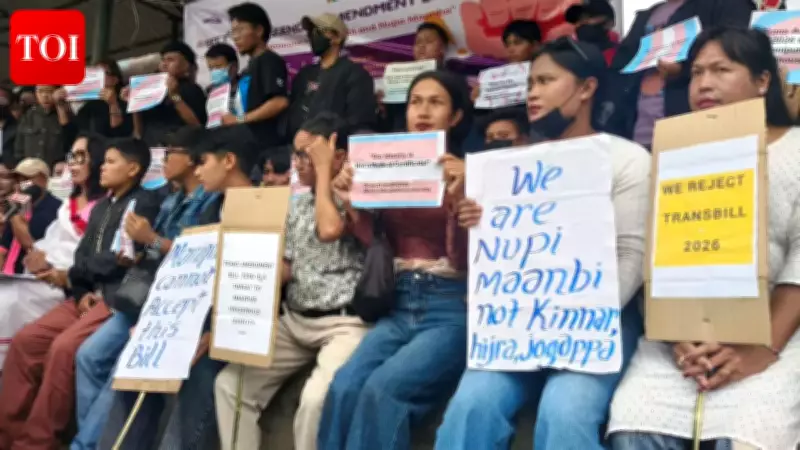
Manipur Transgender Organizations Stage Vigorous Protest Against 'Regressive' 2026 Legislation
In a significant display of dissent, transgender rights groups in Manipur organized coordinated protests on Sunday against the recently passed Transgender Persons (Protection of Rights) Amendment Bill 2026. The demonstrators vehemently condemned the legislation as 'regressive' and fundamentally contradictory to the landmark Supreme Court judgment that affirms the right to self-identification for transgender individuals.
Coordinated Demonstrations Across Imphal
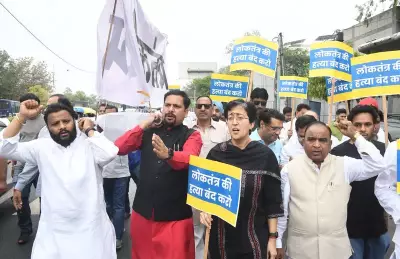
The protest was jointly orchestrated by three prominent organizations: the All Manipur Nupi Manbi Association (AMANA), Empowering Trans Ability (ETA), and the All Trans Men Association (ATMA) Manipur. Activists gathered at two strategic locations—the bustling Mao Market in central Imphal and Keishampat Leimajam Leikai in Imphal West district.
The demonstration commenced with an energetic flash mob performance at Mao Market, capturing public attention through creative expression. Subsequently, participants moved to Keishampat where they staged a solemn sit-in protest. In a powerful symbolic gesture, protesters burned copies of the controversial bill, visually representing their rejection of its provisions.

Fundamental Concerns About Self-Identification Rights
AMANA Secretary Santa Khurai addressed media representatives, articulating the community's profound concerns. "This bill completely undermines the historic NALSA versus Union of India ruling," Khurai asserted. "That Supreme Court judgment explicitly recognized transgender persons' fundamental right to self-identify their gender without external validation or medical certification."
The activist elaborated further: "The proposed legislation is not merely inadequate—it's actively regressive. It attempts to pathologize transgender identity by imposing restrictive, medically-oriented definitions that contradict the principle of self-determination affirmed by our highest court."
Exclusion of Indigenous Gender Identities
A central criticism focused on the bill's alleged failure to recognize diverse indigenous gender identities prevalent across northeastern India. Organizations highlighted that the legislation appears to acknowledge only limited categories such as Hijra, Kinnar, and Jogappa—identities more commonly associated with mainland India.
"This legislation reflects a shallow, homogenizing outlook that ignores India's remarkable diversity," Khurai explained. "In Manipur alone, we have culturally rooted identities like Nupi Manbi and Nupa Manba. Similar indigenous gender expressions exist in Mizoram, Arunachal Pradesh, and Meghalaya. By excluding these communities from legal recognition, the bill effectively risks erasing them from official existence."
Defiant Commitment to Identity and Bodily Autonomy
Khurai delivered a powerful statement of resilience: "We pursued gender-affirming procedures long before this bill was conceived, and we will continue to do so regardless of legislative developments. This is our body. This is our identity. Our existence does not depend on legal validation—we exist, we persist, and we will resist any attempt to undermine our fundamental rights."
Legal Challenge and Wider Mobilization Planned
The protesting organizations revealed concrete plans to escalate their opposition. "We are preparing comprehensive litigation to challenge this bill in the Supreme Court," Khurai confirmed. "We will collaborate with partner organizations across India to build substantial momentum against this regressive legislation."
The protest represents growing resistance to the Transgender Persons Amendment Bill 2026, which both Houses of Parliament recently approved. As the legal battle prepares to move to the nation's highest judicial forum, the confrontation between legislative action and constitutional rights appears destined for significant judicial scrutiny.