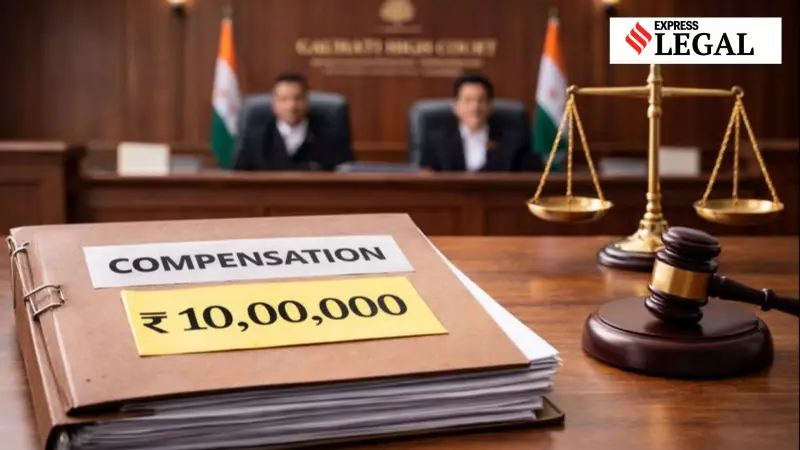
In a significant ruling, the Gauhati High Court has doubled the compensation awarded to a rape survivor from Rs 5 lakh to Rs 10 lakh, while firmly dismissing the appeal filed by the convicted accused. The court underscored the profound impact of sustained abuse on the survivor's emotional state, delivering a verdict that reinforces judicial support for victims of heinous crimes.
Court Rejects Appeal, Highlights Sustained Abuse
The bench comprising Justices Kalyan Rai Surana and Pranjal Das was hearing an appeal against a trial court verdict that had sentenced the accused to 20 years of rigorous imprisonment. The crime involved alleged rape by a relative over a prolonged period, starting when the survivor was about eight years old in 2014-2015 and continuing until June 2021.
While dismissing the appeal on January 21, the High Court noted that the victim had endured abuse from a tender age, which could severely affect her emotional well-being. This consideration played a crucial role in the decision to enhance the compensation amount, reflecting the court's commitment to addressing the long-term consequences of such trauma.
Aadhaar Card Discrepancy Backfires on Accused
During the proceedings, the accused pointed out a discrepancy between the survivor's date of birth on her Aadhaar card and her birth certificate. Specifically, the Aadhaar card listed her birth year as 2006, while the birth certificate showed 2010. The accused attempted to use this inconsistency to argue that the survivor might have been a major at the time of the incidents.
However, the bench clarified that the Aadhaar card contained the actual date of birth, with the age on the birth certificate being reduced for academic purposes. The court held that even if the 2006 date were considered, the survivor was still a minor when the abuse began and throughout its duration. This attempt by the accused to challenge the survivor's age ultimately strengthened the prosecution's case, as it highlighted the accused's efforts to misrepresent facts.
Key Findings and Legal Arguments
The High Court emphasized several critical points in its ruling. First, the survivor's testimony, supported by her statement recorded before a magistrate, was deemed cogent, consistent, and reliable under cross-examination. The court found no basis to show leniency or modify the 20-year sentence imposed by the trial court.
On the legal front, the accused's representative, advocate D Mazumdar, argued that the prosecution failed to prove its case convincingly and raised doubts about the veracity of the incidents, given that other family members were present. Additionally, Mazumdar highlighted the age discrepancy as a potential flaw in the case.
In contrast, additional public prosecutor L Hago contended that the prosecution had cogently proved its case, with the survivor's testimony being consistent and trustworthy. Hago asserted that the accused was rightly convicted for his heinous crime, a position ultimately upheld by the High Court.
Background of the Case
The survivor stated that she was living in her elder brother's house when the accused, a related brother, sexually assaulted her at the age of eight. On one occasion, when she was left alone, the accused forcefully raped her and threatened violence if she complained. The abuse allegedly occurred on multiple occasions between 2014 and 2021.
Following these incidents, the survivor lodged an FIR in 2021. The trial court, in 2024, awarded 20 years of rigorous imprisonment to the accused and ordered a compensation of Rs 5 lakh to the survivor. The High Court's recent decision to double this compensation marks a pivotal moment in ensuring justice and support for the victim.
This ruling not only addresses the immediate legal aspects but also sends a strong message about the judiciary's role in protecting minors and holding perpetrators accountable, regardless of technical arguments like document discrepancies.