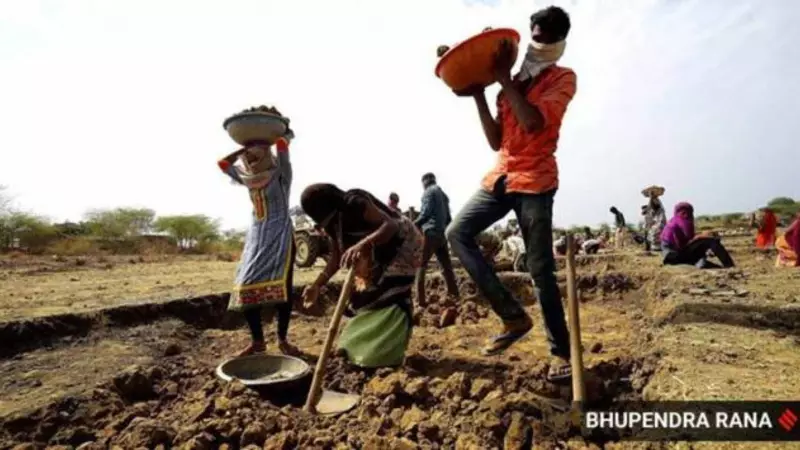
The Narendra Modi government has introduced legislation that fundamentally overhauls India's flagship rural jobs program, sparking debate over the future of employment guarantees. The Viksit Bharat-Guarantee for Rozgar and Ajeevika Mission (Gramin) Bill, 2025, seeks to repeal the Mahatma Gandhi National Rural Employment Guarantee Act (MGNREGA). According to critics, the move represents more than a name change; it signifies the dismantling of a rights-based framework in favor of a conditional, centrally managed scheme.
From Guaranteed Right to Conditional Scheme
The core transformation lies in the law's foundational principles. MGNREGA was a demand-driven right, legally obligating the government to provide work. The new RAM G framework replaces this with pre-fixed, state-wise annual allocations determined by the Centre based on its own "objective parameters." Crucially, any expenditure by a state exceeding this central allocation must be borne entirely by the state government. This effectively means that when the allocated funds are exhausted, the guarantee of work disappears.
The financial burden on states increases substantially. Under MGNREGA, the central government covered the full cost of unskilled manual wages and 75% of material and skilled wage costs. RAM G alters this to a 60:40 cost-sharing ratio for most states and Union Territories with legislatures. For northeastern and Himalayan states, including Uttarakhand, Himachal Pradesh, and Jammu & Kashmir, the ratio is 90:10. This shift is estimated to force states to contribute an additional Rs 50,000 crore or more collectively, with Kerala alone facing an extra burden of Rs 2,000–2,500 crore.

Centralized Control and Social Exclusion Risks
The Bill also centralizes planning and introduces stringent technological mandates, raising concerns about exclusion. While MGNREGA empowered gram panchayats as principal authorities for planning and execution based on local needs, RAM G mandates the use of GIS-based tools, PM Gati Shakti layers, and other digital infrastructure to create Viksit Gram Panchayat Plans. All works are to be aggregated into a central Viksit Bharat National Rural Infrastructure Stack. The law makes biometrics, geo-tagging, and AI audits statutory. For millions of workers with limited digital access, technological failures could lead to exclusion without recourse.
Another contentious provision obligates states to notify a mandatory 60-day hiatus in each financial year when no works will be undertaken, which can include peak agricultural seasons. Critics argue this will force labourers reliant on public works into agricultural labour under private landlords, calling it a form of state-managed labour control rather than a guarantee.
Dilution of Social Safeguards and Cosmetic Changes
The government's headline claim of increasing guaranteed employment days from 100 to 125 is dismissed as "purely cosmetic" by opponents. They warn the Bill enables the exclusion of many rural households through the "rationalisation" of job cards. Furthermore, a significant change is noted in the composition of the central monitoring body.
The MGNREGA-mandated Central Employment Guarantee Council (CEGC) required one-third non-official members to be women and one-third from SC, ST, OBC, and minority communities. The rechristened Central Gramin Rozgar Guarantee Council under Clause 12 of the RAM G Bill omits these reservation criteria. Notably, the corresponding State Councils under Clause 13 retain the representation rules. This selective omission suggests a conscious dilution of social inclusion mandates at the national level, according to the analysis.
The critique, presented by CPI(M) Rajya Sabha member John Brittas in December 2025, frames the RAM G Bill as an annihilation of MGNREGA's soul, converting a legal right into a publicity scheme that burdens states while stripping workers of wage security, choice, and dignity.