

Nagpur Mayor Admits Manual Scavenging Persists Despite Mechanization Claims
Nagpur Mayor Neeta Thakre has made a startling admission that many manholes within the city limits cannot be cleaned mechanically, following a shocking incident reported by TOI where a sanitation worker was forced to dive into a sewer. This statement has intensified scrutiny over whether workers are being compelled into hazardous conditions due to inadequate mechanization, potentially indicating the continued deployment of manual scavengers despite legal prohibitions.
Incident Details and Official Response
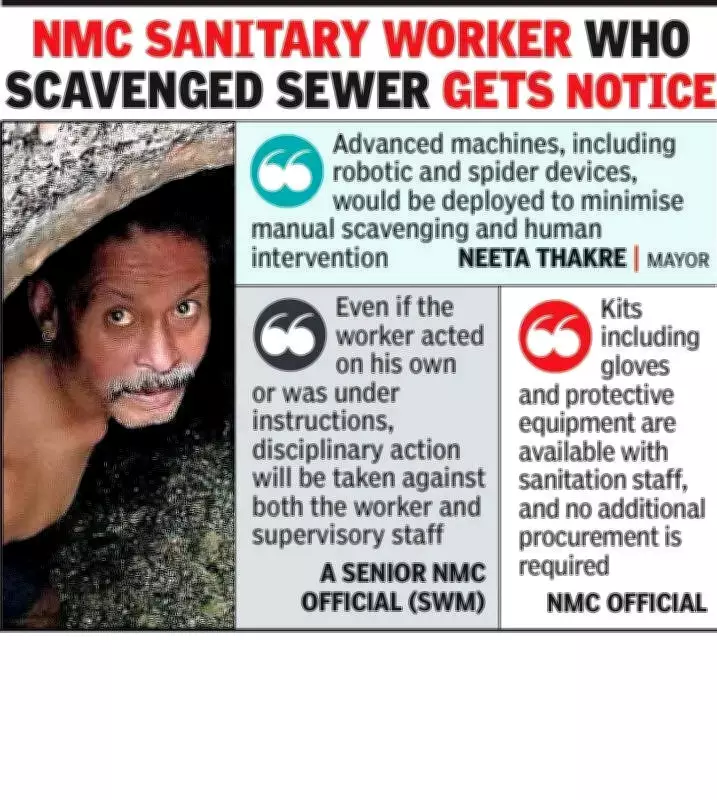
TOI reported that a sanitation worker was found descending into a sewer chamber without any safety gear in Shivaji Nagar under Prabhag 15. The worker attempted to clear a blocked sewer line using a rod, but when the blockage—allegedly caused by stones and debris—could not be cleared from the surface, he entered the manhole. This action violated strict bans on manual entry into manholes. However, even his efforts failed to resolve the chokage. Later, a mechanized suction vehicle was deployed, successfully cleaning the blockage, according to an official.
The Nagpur Municipal Corporation has responded by stating that disciplinary action will be taken against both the worker and supervisory staff. Show-cause notices have been issued to officiating conservancy jamadar Dhanpal Bhimte and sanitary worker Suresh Wankhede for violating the ban. A senior official emphasized, "Even if the worker acted on his own, accountability will be fixed. If he was under instructions, the responsibility extends upwards."

Safety Concerns and Enforcement Issues
Officials claim that safety kits, including gloves and protective equipment, are available with sanitation staff, and no additional procurement is required. However, the incident has raised serious questions about enforcement, training, and on-ground supervision. The worker was neither equipped with oxygen support nor a gas detection device—both mandatory under safety norms—highlighting a gap between policy and practice.
Congress corporator Abhijeet Jha flagged this blatant violation by NMC's solid waste management department and submitted a memorandum to Mayor Thakre, drawing her attention to the incident. This has triggered outrage among civic activists and opposition members, who term it a blatant violation of laws prohibiting manual scavenging. They argue that despite repeated claims of modernization, the ground reality reflects continued dependence on unsafe and illegal practices.
Systemic Challenges and Expert Insights
Experts point out that outdated sewer designs, frequent blockages, and lack of functional machinery are forcing frontline workers to take life-threatening risks. A civil engineer commented, "Without systemic upgrades, such incidents are inevitable." Mayor Thakre assured that advanced machines, including robotic and spider devices, would be deployed to minimize human intervention, but her admission about the limitations of mechanical cleaning has cast doubt on the effectiveness of these measures.
The incident underscores a broader issue in urban governance, where infrastructure deficiencies and enforcement lapses endanger workers' lives. As scrutiny mounts, the focus shifts to whether Nagpur Municipal Corporation can implement genuine reforms to eradicate manual scavenging and ensure worker safety in line with legal mandates.






