

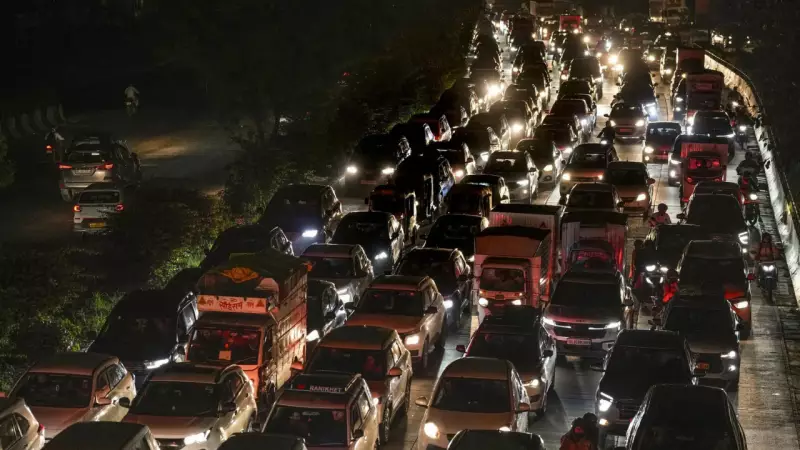
In a significant move to address the capital's perennial gridlock, Delhi authorities have pinpointed 62 fixed congestion hotspots across the city. These are specific locations where traffic snarls are a predictable daily occurrence. The comprehensive list was jointly prepared by the Delhi Traffic Police and validated by multiple agencies including the Public Works Department (PWD), Municipal Corporation of Delhi (MCD), Delhi Metro Rail Corporation (DMRC), and the transport department.
Mapping the Gridlock: From Railway Stations to Markets
The identified bottlenecks are spread throughout the National Capital Territory, affecting every zone. The list includes high-traffic areas such as the approach to New Delhi Railway Station at Bhavbhuti Marg, major intersections like Madhuban Chowk and Punjabi Bagh, commercial hubs like South Extension, residential areas such as Mayur Vihar Phase III, and critical transit points including Kashmere Gate and Anand Visar ISBTs. This widespread distribution highlights how congestion plagues not just arterial roads but also local residential and market zones.
Authorities clarify that a 'hotspot' refers to a specific point on a road stretch, not an entire corridor. These are places where traffic builds up daily due to a combination of structural flaws and operational issues. Common causes identified are narrow carriageways, poorly designed junctions, damaged medians, rampant illegal parking, encroachments by vendors or shopkeepers, and prolonged civil works that shrink usable road space.

Hyper-Local Issues Causing City-Wide Jams
The analysis revealed that some jams originate from very localized problems. A prime example is Boulevard Road near Tis Hazari. Here, vehicles parked by advocates routinely block both carriageways and even two DTC bus stops, creating hours-long snarls on working days. Such hyper-local factors, when multiplied across dozens of locations, contribute significantly to the city's overall traffic paralysis.
In response, the police have initiated immediate measures. Additional traffic personnel have been deployed at these 62 points, with the strength ranging from 5 to over 20 staff per hotspot depending on the severity. Their role is to manually manage flow, regulate violations, and quickly handle breakdowns. High-priority zones for this increased deployment include ISBT Kashmere Gate, Boulevard Road, Kondli Bridge, Vikas Marg, Sardar Patel Marg, and ISBT Anand Vihar.
Beyond Band-Aids: A Multi-Pronged, Long-Term Strategy
Recognizing that more cops on the road is only a temporary fix, authorities are rolling out a coordinated, multi-agency plan aimed at sustainable solutions.
Encroachment removal drives have already begun at more than 40 locations. Key areas being cleared include Sadar Bazar, Qutab Road, Azadpur Mandi, Libaspur underpass, South Extension, Sarai Kale Khan, and the stretch outside Max Hospital in Saket. The goal is to reclaim precious road space and footpaths for pedestrians.
For a lasting structural overhaul, agencies have proposed building new subways, foot overbridges (FOBs), and underpasses at 14 major hotspots. Critical locations slated for such infrastructure upgrades are ISBT Kashmere Gate, Boulevard Road, Kondli Bridge, Kapashera Border, and the Old Delhi–Gurgaon Road. The timelines for these projects vary, with some taking months and others up to two years for completion.
Another key focus is tackling the parking menace. At choke points like the area around Hanuman temples, authorities are exploring solutions such as creating dedicated parking facilities or constructing multi-level car parks to discourage roadside parking. Joint surveys between traffic police and civic agencies are planned to finalise designs and assess feasibility.
Officials emphasize that this hotspot-focused exercise is designed to move beyond temporary measures. The ultimate objective is a blended strategy of continuous enforcement, targeted infrastructure upgrades, and intelligent road design. This coordinated approach aims to provide sustained relief to commuters at some of Delhi's most notorious and congested traffic points.






