

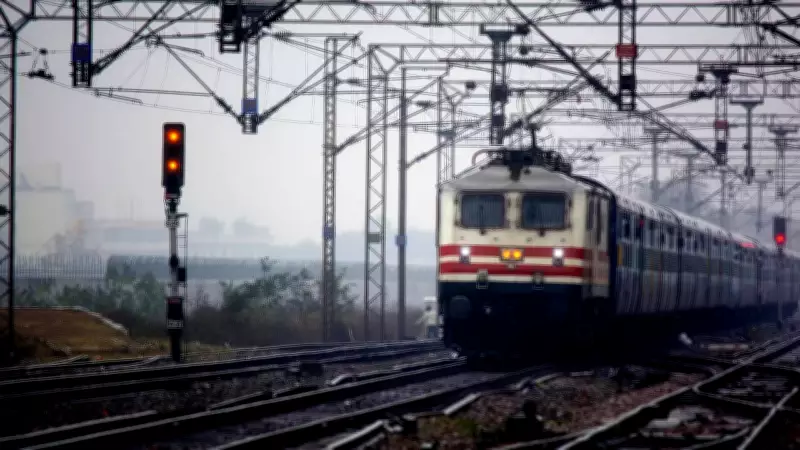
Indian Railways Achieves Major Speed Milestone: 81% Tracks Now Support 110+ Kmph Operations
The Indian government has revealed a significant achievement in railway infrastructure development during the recent Parliament session. According to official data, nearly 81% of the country's railway tracks have been upgraded to support train speeds exceeding 110 kilometers per hour. This represents a remarkable two-fold increase in speed capability compared to the baseline year of 2014.
Comprehensive Network-Wide Upgrade
What makes this achievement particularly noteworthy is its comprehensive nature. Unlike previous limited corridor-based improvements, this speed enhancement has been implemented across the entire railway network. Government statistics show that 84,888 kilometers out of the approximately 110,000-kilometer railway network have been upgraded to support speeds of 110 kmph and above.
Even more impressive is that 23,477 kilometers of this upgraded infrastructure now allows train operations at 130 kmph and higher speeds. This represents approximately one-fifth of the existing track network capable of supporting these elevated speed thresholds.

Enabling Next-Generation Train Services
This systemic infrastructure upgrade is directly facilitating the introduction of India's new-generation train services. The enhanced track capabilities are enabling the operation of both chair car and sleeper variants of Vande Bharat trains, along with Amrit Bharat trains, all designed to operate at significantly faster speeds than conventional services.
A Unique Approach to Railway Modernization
Railway experts emphasize that India's approach to speed enhancement represents a fundamentally different strategy compared to other nations. While countries like China, Japan, and France have primarily achieved higher speeds through constructing new, passenger-exclusive high-speed rail lines, India has pursued a more complex path.
The Indian strategy has focused on upgrading existing tracks that carry mixed traffic—both passenger and freight services—which presents far greater technical challenges than building segregated high-speed corridors. This approach requires strengthening track geometry, modernizing signaling systems, implementing electrification, and enhancing safety protocols—all while maintaining daily operational continuity.
Creating a Graduated Speed Ecosystem
Railway Ministry officials explained that India's strategy involves progressively upgrading large contiguous stretches of tracks from 110 kmph to 130 kmph, with further enhancements to 160 kmph capabilities. This creates what officials describe as a "laddered speed ecosystem" rather than creating sharp divisions between conventional "slow" lines and isolated high-speed routes.
"Such gradation allows trains, crew training programs, and signaling systems to evolve organically, significantly reducing transition risks and operational disruptions," explained a senior railway official.
Nationwide Implementation and Benefits
The speed capability enhancements are distributed across all railway zones, including freight-intensive regions such as East Central Railway, South East Central Railway, and South Central Railway. This ensures national uniformity in railway operations and prevents the creation of elite, passenger-centric corridors that might become disconnected from the broader network.
Indian Railways operates under uniquely challenging conditions that make these speed upgrades particularly impressive. The system runs some of the world's longest freight trains, transports over 2.5 crore passengers daily, operates with heavy axle loads ranging from 22.9 to 25 tonnes, and maintains long welded rails with full electrification and increasingly automated signaling—all on the same tracks that now support higher speeds.
Railway authorities note that no other railway system globally has attempted speed upgrades of this magnitude under such complex operational constraints, making India's achievement particularly significant in the global transportation landscape.






