

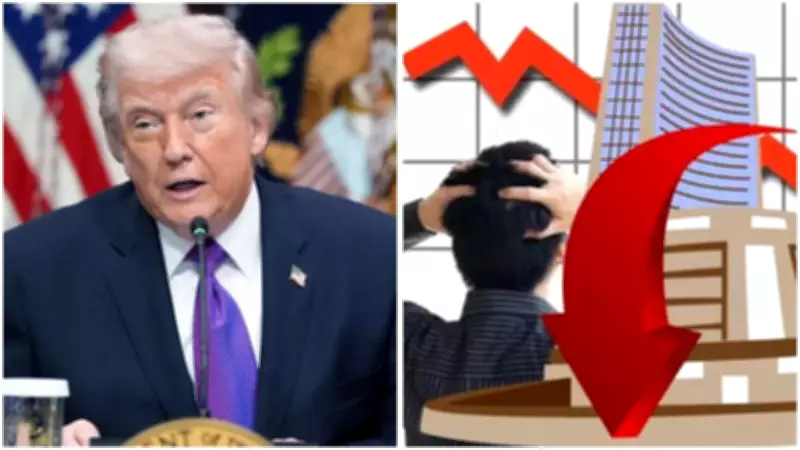
Trump Announces Five-Day Pause on Planned Iran Strikes After 'Productive' Talks
In a significant development, US President Donald Trump declared a five-day pause on planned military strikes targeting Iranian power plants and energy infrastructure. This decision followed what he described as "very good and productive" discussions between Washington and Tehran over the preceding two days. The move signals a potential de-escalation in the tense standoff, coming after Trump's earlier 48-hour ultimatum concerning the strategic Strait of Hormuz.
Iran Claims Trump 'Backed Down' as Oil Prices React Sharply
Iran responded assertively to the announcement, with its mission in Kabul stating that Trump had effectively "backed down" in the face of Iran's firm warnings. The geopolitical shift had an immediate and profound impact on global oil markets. Brent crude, the international benchmark, experienced a sharp decline, plunging below the $100 per barrel mark and briefly touching around $96. This volatility underscores the market's sensitivity to developments in the region.
PM Modi Highlights 'Unprecedented Challenges' for India
Prime Minister Narendra Modi addressed Parliament, emphasizing that the ongoing Middle East conflict has created "unprecedented challenges" for India. He cited the war's far-reaching impact on the global economy, critical energy supplies, and the safety of the large Indian diaspora in the Gulf region. PM Modi noted that nearly 1 crore Indians reside in the area and confirmed that over 3.75 lakh citizens have been safely repatriated since the conflict began, including approximately 1,000 individuals from Iran.

Mystery Deepens with Second Suspected 'Zombie Ship' in Hormuz
The strategic Strait of Hormuz witnessed another maritime mystery as a second suspected "zombie ship" was reported crossing the vital chokepoint. A vessel, allegedly using the identity of the tanker 'Nabiin', transited the strait despite official records indicating the real 'Nabiin' was scrapped in Bangladesh five years ago. This incident follows a similar case involving the 'Jamal' just days earlier, pointing to unusual and potentially deceptive tactics by operators attempting to navigate cargo through the war-affected waterway.
Indian Markets Crash Amid Oil Shock and War Fears
Indian financial markets faced a severe downturn as escalating US-Iran tensions and surging crude oil prices triggered a massive selloff. The benchmark Sensex plummeted by 1,837 points, while the Nifty index closed down by 602 points. Investor sentiment was severely damaged by multiple factors: Brent crude prices soaring above $110 per barrel, the Indian rupee hitting a record low, persistent foreign institutional investor (FII) outflows, and a broader global risk aversion. The collective market capitalization erosion was staggering, with an estimated Rs 14 lakh crore wiped out in a single day.
Intelligence Agencies Probe Iran's Power Structure
Amid the crisis, intelligence agencies including the CIA and Israel's Mossad are reportedly investigating a potential power vacuum within Iran's leadership. Questions are being raised about the extent of control wielded by Mojtaba Khamenei, son of Supreme Leader Ayatollah Ali Khamenei, and uncertainty persists over who ultimately commands Tehran's strategic decisions during this critical period.
Regional Tensions and Rhetoric
The situation remains highly volatile, with Iran vowing a tit-for-tat response to any US strike and threatening to target US-Israeli energy facilities. In a separate and inflammatory statement, a former Pakistani envoy suggested that if America were to strike Iran, the response should include attacks on Indian cities like Delhi and Mumbai, highlighting the complex and interconnected nature of regional geopolitics.






