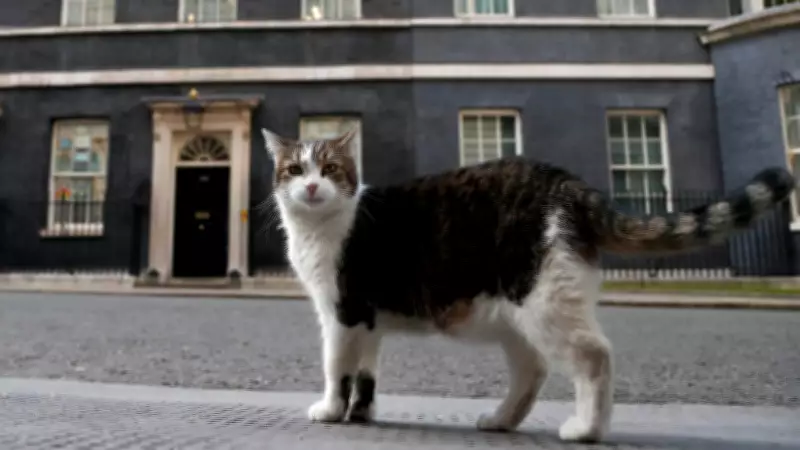
Larry the Cat Celebrates 15 Years as Britain's Enduring Chief Mouser
In a political landscape frequently characterized by upheaval and leadership transitions, one resident of 10 Downing Street has remained a steadfast constant. Larry, the British government's official Chief Mouser, marked an impressive 15 years in his prestigious role on Sunday, solidifying his position as one of the most enduring figures associated with the prime minister's residence.
From Humble Beginnings to Political Icon
First adopted from Battersea Dogs and Cats Home by then-Prime Minister David Cameron, the distinctive gray-and-white tabby arrived at Downing Street on February 15, 2011. Since that fateful day, Larry has served under six consecutive prime ministers, cultivating a reputation as both a powerful symbol of continuity and an unofficial mascot of British political life.
"In turbulent political times, stability comes with four legs, whiskers and a fondness for napping," observed Philip Howell, a Cambridge University professor specializing in human-animal relations. "Larry the cat's approval ratings will be very high," Howell added. "And prime ministers tend not to hit those numbers. He represents stability, and that's at a premium."

Official Duties and Unofficial Influence
According to his official government profile, Larry's responsibilities include "greeting guests to the house, inspecting security defenses and testing antique furniture for napping quality." In practice, his presence has consistently extended far beyond these ceremonial duties. The charismatic feline has become a familiar fixture for photographers stationed outside Downing Street, frequently making appearances that coincide with high-profile political arrivals.
"He's great at photo-bombing," remarked freelance photographer Justin Ng, who has covered Downing Street for years. "If there's a foreign leader that's about to visit then we know he'll just come out at the exact moment that meet-and-greet is about to happen."
Encounters with World Leaders and Political Pets
Over his remarkable tenure, Larry has encountered a succession of world leaders, sometimes compelling visiting dignitaries to navigate around him on the famous black doorstep. Observers have noted that while he can be selective in his affections—reportedly less friendly toward men—he appeared comfortable around former U.S. President Barack Obama and drew a genuine smile from Ukrainian President Volodymyr Zelenskyy during one memorable visit.
During Donald Trump's 2019 visit to London, Larry famously wandered into the official photo opportunity before settling down beneath the presidential limousine known as "The Beast."
Despite his official title, assessments of Larry's rodent-catching abilities have varied. He has occasionally been photographed catching mice and once attempted to capture a pigeon, which ultimately escaped. Ng described the cat's appeal differently: "He's more of a lover than a fighter. He's very good at what he does: lounging around and basically showing people that he's very nonchalant."
Rivalries and Coexistence in the Political Arena
Life at Downing Street has also included notable rivalries and uneasy coexistence with other political pets. Larry shared space with Boris Johnson's Jack Russell cross Dilyn and Rishi Sunak's Labrador Nova. Under current Prime Minister Keir Starmer, Larry remains confined to the working areas, while the Starmer family's cats, JoJo and Prince, stay in the private residential quarters.
Perhaps his most famous rivalry was with Palmerston, the Foreign Office's resident cat across the street. The two were repeatedly photographed in dramatic confrontations before Palmerston retired in 2020. Palmerston died earlier this month in Bermuda, where he had taken on the honorary role of "feline relations consultant" to the governor.
Aging Gracefully and Cultural Significance
Now believed to be 18 or 19 years old, Larry has slowed with age but continues to patrol Downing Street and spend long stretches resting on a window ledge above a radiator near the entrance—a familiar and comforting sight for visitors and staff alike.

For many observers, Larry's enduring popularity reflects something deeper in British political culture. Howell argues that the cat occupies a unique space as a nonpartisan presence in a highly partisan environment.
"A cat-hating PM, that seems to me to be political suicide," Howell stated emphatically.
Unlike American presidential pets, which are often viewed as extensions of political image-making, Larry's appeal lies partly in his independence. "The fact that cats are less tractable is part of the charm, too," Howell explained. "He's sort of whimsically not partisan in a political sense, but he tends to take to some people and not to others and he won't necessarily sit where you want him to sit and pose where you want him to pose."
"There is a certain kind of unruliness about Larry which I think would endear him, certainly, to Brits."
As Larry enters his sixteenth year of service, his legacy as Britain's most famous political animal continues to grow, offering a unique perspective on power, permanence, and the unpredictable nature of both politics and feline behavior.