

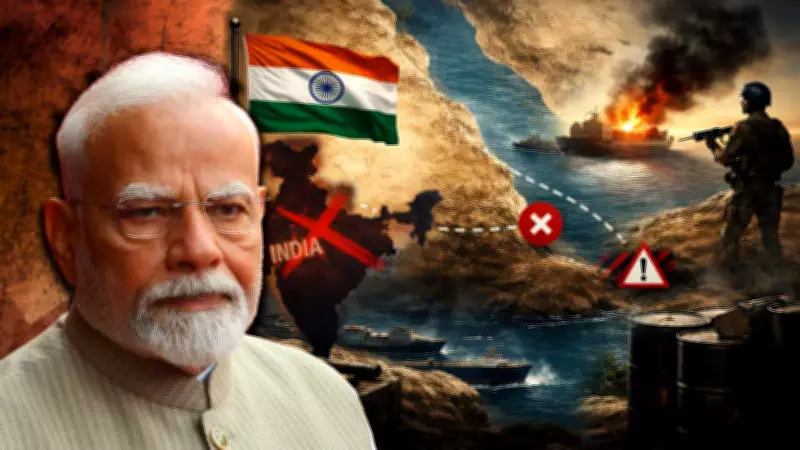
India's Strategic Maritime Gap: The Missing Red Sea Presence
In the complex chessboard of global geopolitics, Djibouti has emerged as a pivotal square, hosting the world's most concentrated hub of foreign military bases. Located at the southern entrance to the Red Sea, this small nation sits along the Bab el-Mandeb strait, a critical chokepoint for international trade and energy flows, making it central to power projection across the Red Sea and the Indian Ocean.
A Hub of Global Military Power
The strategic importance of Djibouti is underscored by the presence of military installations from major global players. United States, China, France, and Japan have all established permanent bases here, transforming the region into a nexus of naval and military activity. This concentration of foreign forces highlights Djibouti's role as a gateway to one of the world's most vital maritime corridors.
India's Approach: Strategic Restraint Over Sovereign Presence
Despite India's significant expansion of its maritime footprint across the Indian Ocean, it maintains no permanent military presence in Djibouti. Instead, India operates through access agreements with partner nations, allowing it to use allied facilities without establishing sovereign infrastructure. This model reflects India's long-standing policy of strategic restraint on overseas basing, shaped by:

- Doctrinal caution in military deployment
- Political sensitivities regarding foreign bases
- A preference for flexible engagement models over permanent installations
Geopolitical Complexities and Rival Powers
The prospect of an Indian base in Djibouti is further complicated by the region's intricate geopolitical environment. The presence of rival powers, particularly China, adds layers of strategic competition that make sovereign basing a delicate proposition. China's established military footprint in Djibouti represents both a challenge and a constraint for India's maritime ambitions in the area.
Operational Limitations in a Critical Region
However, evolving security dynamics in West Asia have begun to highlight the operational limitations of India's current approach. The absence of a forward logistics hub near the Red Sea constrains several key capabilities:
- Rapid deployment of naval assets in response to emerging threats
- Sustained presence for continuous maritime surveillance
- Real-time maritime awareness in one of the world's most critical regions
This gap becomes particularly significant as the Bab el-Mandeb strait handles substantial volumes of global trade, including energy shipments that are vital to international economies. India's reliance on access agreements, while diplomatically prudent, may not provide the same level of operational readiness as a dedicated forward base.
The Future of India's Maritime Strategy
As India continues to expand its naval network across the Indian Ocean, the question of Djibouti remains a strategic puzzle. The country's approach balances traditional restraint with modern security needs, but the evolving landscape of West Asian conflicts and great power competition may necessitate reevaluation. Whether India will maintain its current model or seek more permanent arrangements in critical chokepoints like the Red Sea will significantly influence its future as a maritime power.






