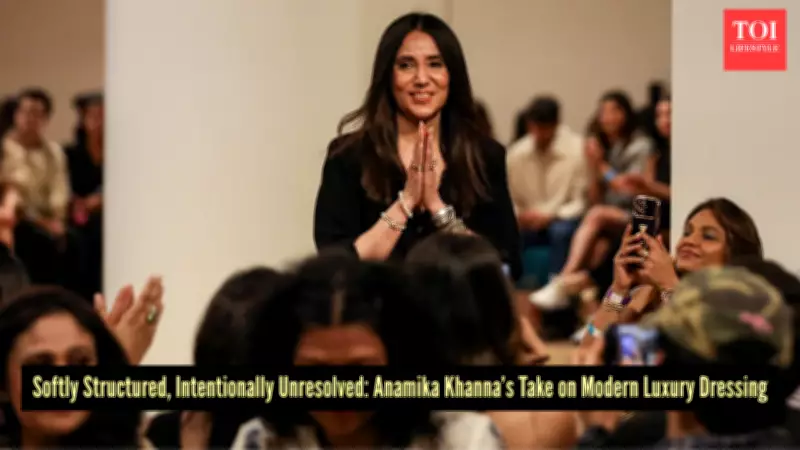
Anamika Khanna's Vision: Celebrating Imperfection in Modern Indian Fashion
As the Indian fashion landscape increasingly prioritizes wearable designs with global appeal, visionary designer Anamika Khanna is charting a distinctly different course. Rather than pursuing conventional perfection, she is deliberately rewriting fashion narratives through intentionally "imperfect" silhouettes that challenge traditional aesthetics.
Lakme Fashion Week 2026: A Showcase of Artistic Freedom
In an exclusive conversation, the founder of AK|OK reveals the philosophy behind her recent Lakme Fashion Week 2026 presentation, which centered on themes of ease, artistic freedom, and asymmetrical designs featuring raw edges. For Khanna, these imperfections are neither accidental nor incidental—they represent carefully considered design choices that fundamentally enhance a garment's tactile and emotional qualities.
"The core idea was imperfection," Khanna explains. "I kept returning to the concept that elements don't always need perfect resolution or placement to achieve beauty. Sometimes, it's perfectly acceptable to let things simply exist as they are."

Translating Philosophy into Wearable Art
Her Spring/Summer 2026 collection materialized this philosophy through garments that deliberately avoided overworked appearances. Through strategic asymmetry, unfinished edges, and surfaces that emphasized handcrafted textures over mechanical precision, Khanna created clothing that felt authentic and organically evolved rather than forcibly constructed.
"It wasn't about creating theatrical drama," she clarifies. "Rather, it was about allowing clothing to feel genuine, as if it had developed naturally over time instead of being coerced into a predetermined final form."
The Delicate Balance: Intentional Imperfection Versus Carelessness
When questioned about how she ensures these deliberate "flaws" maintain refinement and desirability, Khanna draws a crucial distinction: "For me, imperfection represents consideration, not carelessness. There's a fundamental difference between something being unfinished versus intentionally unresolved."
She emphasizes the irreplaceable value of human touch in craftsmanship, noting that "human irregularity creates deeper refinement." Even when designs appear imperfect, they remain anchored by meticulous technique, traditional craft, and proportional balance—elements that preserve their appeal.
Navigating India's Fashion Evolution
Reflecting on Indian fashion's transition from traditional couture to globally-oriented hybrid designs, Khanna reveals she has been navigating this shift long before it became industry conversation. "There was a pivotal moment when I realized people don't want costumes—they want edited pieces they can genuinely live in," she recalls.
This realization transformed her design approach, blending Indian aesthetic elements with global understandings of fit, structure, and wearability. Today, she views this not as a disruptive shift but as natural progression toward creating pieces that transcend geographical boundaries and belong authentically to their wearers.
Resisting Fast Fashion While Evolving Craftsmanship
In an era dominated by rapidly accelerating fast fashion trends, Khanna remains committed to preserving Indian craftsmanship integrity. "Craftsmanship operates on its own rhythm that deserves respect—it cannot and should not keep pace with fast fashion," she asserts.
She emphasizes beginning with the karigar (artisan) and their process, which cannot be rushed. Simultaneously, she acknowledges that "craft cannot remain static; it must evolve to maintain contemporary relevance." By integrating traditional techniques into modern contexts, craftsmanship naturally becomes part of everyday wardrobes, ensuring its continued vitality.
The Modern Indian Consumer: Design-Aware and Flexible
Khanna observes significant evolution in Indian consumer consciousness: "Today's consumers are increasingly design-aware rather than merely brand-conscious. They seek understanding about how garments are made, how they feel, and how they integrate into daily life."

The modern wearer desires flexibility over formality, she notes, with contemporary collections focusing less on specific occasions and more on versatile possibilities.
Future Directions: Evolving Fluidity and Adaptability
Looking forward, Khanna views imperfection and fluidity not as passing trends but as enduring design philosophies. "I plan to further explore adaptability—creating clothing that can be worn multiple ways, that transforms with the wearer, and that evolves alongside the person who inhabits it rather than imposing predetermined forms," she reveals.
This ongoing exploration promises to continue challenging fashion conventions while celebrating the beautiful imperfections that make clothing genuinely human.