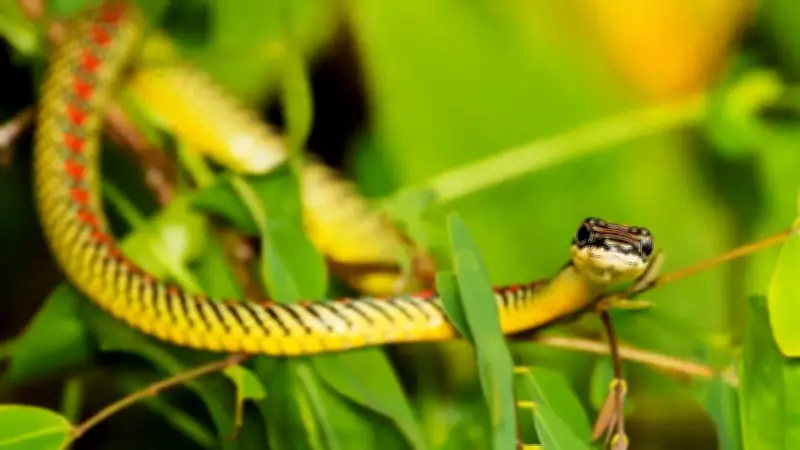
Flying Snakes of Asia: The Limbless Gliders Defying Nature's Norms
Snakes are typically envisioned as silent creatures slithering across the ground, navigating through tall grasses and sandy terrains with stealth. However, a remarkable group of snakes found in parts of Asia shatters these conventional perceptions, showcasing an extraordinary ability that challenges our understanding of reptilian movement.
Introducing the Aerial Acrobats: What Are Flying Snakes?
Flying snakes, belonging to the genus Chrysopelea, are a fascinating family of slender, tree-dwelling reptiles capable of gliding through the air as they transition from one tree to another. Unlike birds or bats, these snakes achieve this feat without the aid of wings or limbs, relying solely on their unique body structure and specialized movements. This adaptation allows them to thrive in their arboreal environments, making them a subject of intrigue for scientists and nature enthusiasts alike.
Species, Habitat, and Distribution of Flying Snakes
The genus Chrysopelea encompasses several species distributed across South and Southeast Asia. Key regions include India, Sri Lanka, Thailand, Malaysia, Indonesia, southern China, and the Philippines. Common species include:

- Golden Tree Snake (Chrysopelea ornata): Found in India and Southeast Asia, known for its vibrant coloration and size.
- Paradise Tree Snake (Chrysopelea paradisi): Inhabits Southeast Asia, prized for its agility in gliding.
- Twin-Barred Tree Snake (Chrysopelea pelias): Another species native to the region.
- Sri Lankan Flying Snake (Chrysopelea taprobanica): Endemic to Sri Lanka, adding to the diversity of this genus.
These snakes predominantly reside in trees, descending only when necessary. Their habitats are characterized by dense tropical rainforests, wooded areas, and plantations, where a continuous canopy provides an ideal environment for gliding. Notable locations include the Western Ghats in India, rainforests in Indonesia, and forests in Thailand and Malaysia. The canopy acts as a natural highway, enabling the snakes to glide above the ground, thereby avoiding predators and conserving energy.
The Mechanics of Gliding: How Do Flying Snakes Fly?
The gliding ability of flying snakes is one of the most captivating adaptations in the reptile world. When leaping from a branch, these snakes extend their ribs, causing their bodies to flatten significantly. This flattening increases the surface area interacting with the air, creating aerodynamic lift that facilitates gliding. Research published in the Journal of Experimental Biology confirms that this body modification allows them to glide distances of up to 100 meters without wings, showcasing an efficient use of physics in nature.
Evolutionary Advantages: Why Did Flying Snakes Develop This Trait?
Gliding is not merely a rare characteristic but a critical survival adaptation. In dense jungles, descending to the forest floor exposes snakes to predators such as hawks and other large animals. By remaining aloft in the trees, flying snakes minimize this vulnerability. Additionally, gliding enables rapid movement between food sources. Their diet primarily consists of lizards, frogs, and small birds, which are often located in arboreal settings, making this mode of travel highly advantageous for foraging.
Size and Species Variations: The Largest Flying Snakes
Among the various species, the golden tree snake stands out as one of the largest, capable of growing up to four feet in length. Its size and striking coloration make it relatively easy to spot in its natural habitat. However, larger size does not necessarily enhance gliding performance. Species like the paradise tree snake, with greater flexibility, often exhibit superior gliding capabilities compared to their bulkier counterparts, highlighting the importance of agility in aerial movement.

A Rare Phenomenon in Nature: The Uniqueness of Flying Snakes
Flying snakes represent one of the few limbless reptiles documented to possess gliding abilities. Unlike winged creatures, they utilize their entire body for aerodynamics, a trait that has captivated scientists studying non-winged flight mechanisms. This unique adaptation continues to inspire research into how animals achieve aerodynamic efficiency without traditional structures like wings, offering insights into evolutionary biology and biomechanics.