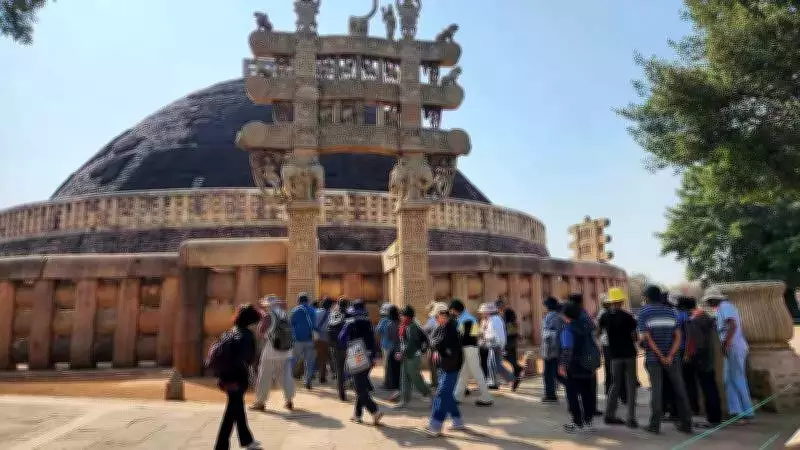
Sanchi's Historical Significance Overshadowed by Budget 2026's Northeast Focus
Sanchi, the ancient Buddhist sanctuary located in Madhya Pradesh and designated as a UNESCO World Heritage Site, continues to face systematic neglect despite its profound historical importance dating back to the 3rd century BCE when it was commissioned by Emperor Ashoka. The recent Union Budget 2026-27 has brought this issue into sharp focus once again.
Budget 2026's Buddhist Circuit Initiative Excludes Sanchi Again
In the Union Budget 2026-27, Finance Minister Nirmala Sitharaman announced a significant new scheme to develop Buddhist circuits in northeastern 'Purvodaya' states, specifically targeting Arunachal Pradesh, Sikkim, Assam, Manipur, Mizoram, and Tripura. The initiative focuses on preserving temples and monasteries to boost tourism in these regions.
This marks the second major exclusion for Sanchi in recent government planning. Back in 2014, then-Finance Minister Arun Jaitley unveiled a Buddhist circuit linking Sarnath, Gaya, and Varanasi, which similarly bypassed Sanchi entirely. The pattern of oversight has raised serious concerns among heritage experts and conservationists.

Sanchi's Architectural and Historical Treasures
The Sanchi complex represents one of India's most important archaeological sites, featuring:
- The iconic Great Stupa (Stupa 1), a magnificent hemispherical structure
- Several smaller stupas scattered throughout the complex
- Ancient temples that showcase early Buddhist architecture
- Historical pillars with inscriptions
- Four intricately carved gateways from the 1st century BCE, renowned for their detailed sculptures depicting Buddhist legends and everyday life
These structures collectively represent a living testament to India's Buddhist heritage and architectural evolution over centuries.
Expert Criticism and Calls for Preservation
Heritage experts have strongly criticized the repeated oversight of Sanchi in government initiatives. "Sanchi isn't just ruins—it's living history. Such neglect must end," emphasized senior architect Professor Sheetal Sharma, who has recently worked on heritage preservation projects including AR/VR and metaverse experiences in collaboration with the Archaeological Survey of India (ASI).
Professor Sharma further noted, "While the Northeast certainly needs focus and development, systematically ignoring Sanchi weakens India's role as Buddhism's global steward. We need a balanced approach that preserves all significant heritage sites."
The Broader Context of Heritage Preservation Challenges
The exclusion of Sanchi from successive Buddhist circuit development plans highlights broader challenges in India's heritage preservation strategy:
- Geographical Imbalance: Development initiatives tend to cluster around certain regions while neglecting others with equal historical significance
- Tourism Potential: Sanchi's exclusion represents missed opportunities for cultural tourism and economic development in Madhya Pradesh
- Conservation Needs: The site requires sustained investment for maintenance, research, and visitor infrastructure
- Global Recognition: As a UNESCO World Heritage Site, Sanchi deserves attention commensurate with its international status
The ongoing neglect raises questions about whether India's heritage preservation efforts are adequately distributed across the country's diverse historical sites.