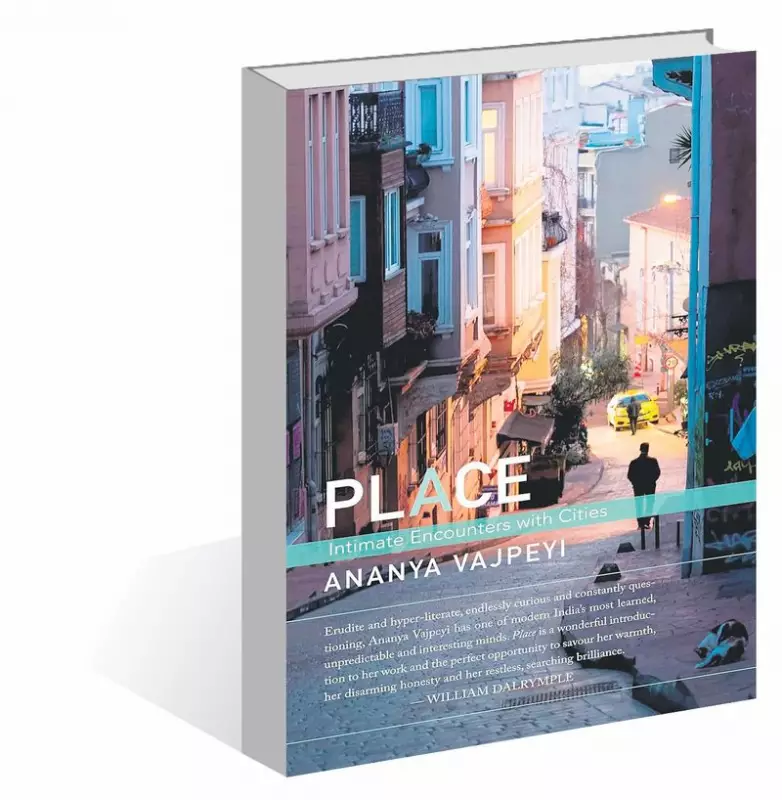
In a world saturated with GPS coordinates and rigid official boundaries, a new book offers a profoundly human alternative for understanding urban spaces. Ananya Vajpeyi's Place: Intimate Encounters with Cities invites readers on a journey through the unofficial, emotional, and deeply personal maps that truly define a city's character.
Beyond Official Cartography: The Personal as Political
Vajpeyi, a respected fellow at the Centre for the Study of Developing Societies (CSDS) in Delhi, moves far beyond traditional geography. Her work, published by Westland Books, constructs its narratives around personal memory, sensory experience, and historical reflection. The book is structured as a series of intimate encounters with five distinct urban landscapes: Delhi, Varanasi, Kolkata, Bhubaneswar, and Hyderabad.
Each chapter acts as a unique map, charted not with streets and landmarks, but with the author's lived experiences, family histories, and intellectual engagements. This approach challenges the impersonal nature of official maps, arguing that the true essence of a place is often found in the unofficial stories etched into its fabric.

Charting the Soul of Delhi and Varanasi
The exploration of Delhi is particularly poignant. Vajpeyi maps the city through the lens of personal and national trauma, connecting the assassination of Mahatma Gandhi in 1948 to more recent violence. She navigates neighborhoods like Jangpura, Bhogal, and Nizamuddin, weaving together threads of grief, memory, and the city's relentless transformation. This is not the Delhi of tourist guides, but a city felt in the bones of its history.
In contrast, the chapter on Varanasi presents the ancient city as a living, breathing entity of sacred geography. Vajpeyi delves into the intimate relationship between the city's ghats, the Ganga river, and the cycle of life and death. Her mapping here is spiritual and sensory, capturing the sounds, smells, and rituals that have defined Banaras for millennia. She reflects on how such cities hold space for both the eternal and the ephemeral.
A Tapestry of Urban Identities Across India
The book's scope extends to other metros, each with its own unique cartography. Kolkata is examined through its rich intellectual and political history, a city of ideas and revolutions. Bhubaneswar is explored in the context of its modernist architecture and Odia identity, while Hyderabad is framed by its distinctive Deccani culture and linguistic heritage.
Throughout, Vajpeyi employs a multi-disciplinary lens, drawing from history, political theory, literature, and personal anecdote. This method allows her to create composite portraits that are far richer than any single perspective could provide. The book argues that to know a city, one must engage with its layers of memory, conflict, beauty, and decay.
Redefining Our Relationship with Urban Spaces
Place: Intimate Encounters with Cities is more than a collection of essays; it is a methodological intervention in how we perceive urban life. By prioritizing the intimate and the unofficial, Vajpeyi offers readers a tool to reclaim their own narratives of the cities they inhabit or visit. It champions a form of deep, attentive belonging that stands against the homogenizing forces of rapid development.
The book's ultimate power lies in its invitation. It asks each reader to consider their own unofficial maps—the routes of daily commute that hold private significance, the corners associated with personal joy or sorrow, the spaces where community is built and history is felt. In doing so, Vajpeyi's work becomes a vital contribution not just to urban studies, but to the broader understanding of place, identity, and memory in contemporary India.