RSS Chief Mohan Bhagwat Announces Strategic Shift: Focus on Youth, Social Media
Nagpur: In a significant address outlining the future trajectory of the Rashtriya Swayamsevak Sangh (RSS), Sarsanghchalak Mohan Bhagwat on Thursday detailed a calibrated shift in the organization's functioning. Speaking at an interaction at the Suresh Bhat Auditorium, Bhagwat emphasized a renewed focus on outreach to younger generations and the responsible use of social media, all while steadfastly retaining the Sangh's ideological core.
Adapting to Modern Challenges While Preserving Core Ideology
Highlighting the RSS's evolutionary journey in response to changing societal landscapes, Bhagwat noted that the organization continues to adapt its approach while remaining deeply rooted in its foundational principles. He reflected that at the time of its inception, the nation was grappling with subjugation, invasions, and communal unrest, which fundamentally shaped the Sangh's early expression and operational methods.
"Today, the challenges are different, and accordingly, the approach must change," Bhagwat asserted, explaining that this necessary transformation is expected to percolate from the top leadership down to every swayamsevak at the grassroots level. This strategic recalibration is seen as essential to remain relevant and effective in contemporary India.

Embracing Digital Platforms with Caution and Clarity
Addressing the pervasive influence of digital media, Bhagwat revealed that the RSS has begun actively engaging with social media creators to communicate its perspective to a wider audience. However, he stressed the importance of caution in this digital foray.
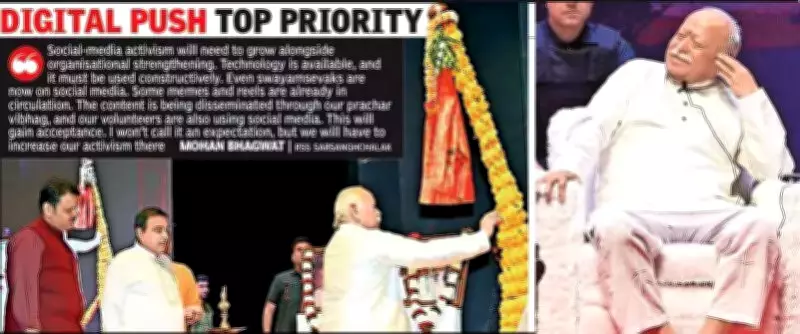
"Clarity of thought, appropriate language, and credibility should be maintained while communicating," he advised, adding that the organization has introduced specific training initiatives to equip volunteers with the necessary technological skills. Bhagwat emphasized that social media activism must grow in tandem with organizational strengthening, viewing technology as a tool to be used constructively.
He noted that even swayamsevaks are now active on social media platforms, with some memes and reels already in circulation. Content is being disseminated through the prachar vibhag (publicity department), and volunteers are increasingly leveraging these digital channels. "This will gain acceptance. I won't call it an expectation, but we will have to increase our activism there," Bhagwat stated, signaling a committed push into the digital arena.
Targeting Gen Z with Technology and Urban Outreach
Focusing specifically on Generation Z, the RSS chief observed that the younger demographic shows a "natural ideological resonance" with the Sangh, particularly around shared aspirations for national growth and development. However, he candidly acknowledged the challenge of sustaining this engagement over time.
To address this, Bhagwat detailed that concerted efforts are underway to expand youth participation through innovative use of technology, targeted communication strategies, and proactive outreach in urban spaces. This includes engaging with communities in high-rise buildings and gated societies, areas traditionally less penetrated by the organization.
Maintaining Discipline and Restraint in Favorable Times
Bhagwat also underscored the critical need for internal discipline and restraint, especially during periods of favorable public perception. "We need to ensure that we should not become publicity-oriented, even in favourable times," he cautioned, describing the current phase as a "real test" for the organization. The goal is to prevent any deviation from core principles amidst growing influence and visibility.
Organizational Restructuring and Decentralization
In response to rising public expectations and an expanded demand for volunteers, Bhagwat announced moves toward greater decentralization. The RSS is developing smaller operational units and a new "pradesh-level" coordination mechanism to streamline engagement with government bodies and administrative authorities.

Furthermore, the organization plans a significant structural overhaul, restructuring its framework from the current 46 regions to 86 divisions. This expansion is designed to enhance operational efficiency and local responsiveness while meticulously maintaining the core functioning and ideological integrity of the Sangh.
Ideological Initiatives and Centenary Documentation
On broader ideological fronts, Bhagwat referred to the "Panch Parivartan" initiative as a comprehensive effort aimed at societal transformation through changes in lifestyle. He noted that while the concept has gained considerable acceptance, its successful implementation will require sustained and deliberate behavioral change across communities.
Responding to questions about public discourse where his remarks are sometimes misinterpreted, Bhagwat addressed the issue directly. "Statements are sometimes taken out of context and presented differently," he said, adding that such instances have necessitated more careful and precise communication from the leadership.
As part of its ongoing centenary initiatives, the Sangh has directed all its units to meticulously document publications and reports related to its extensive work. These materials are planned to be archived and later analyzed at the national level, preserving the historical record of the organization's contributions.
A Personal Anecdote and Dignitaries in Attendance
On a lighter note, Mohan Bhagwat shared a personal anecdote, revealing that he once enjoyed watching English films, though his demanding schedule now rarely allows time for such leisure. He added that the last English film he watched was over a decade ago—The Lord of the Rings.
The interaction was attended by several dignitaries, including Union Minister Nitin Gadkari and Chief Minister Devendra Fadnavis, underscoring the event's significance within political and organizational circles.