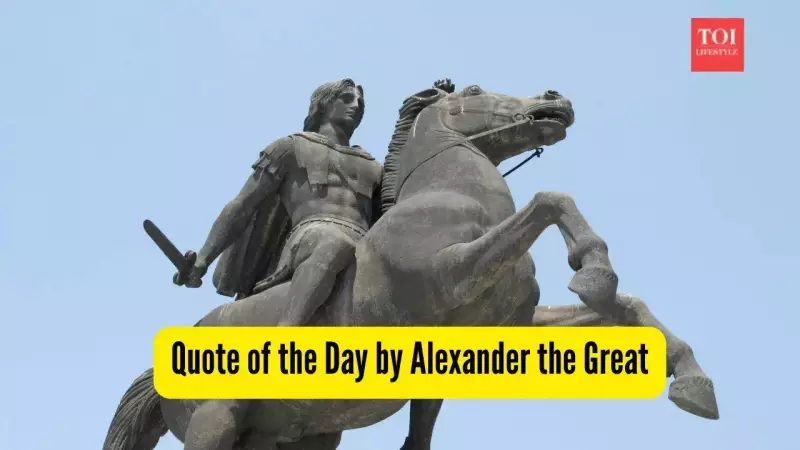
More than 2300 years after his death, the story of Alexander the Great continues to capture the global imagination. His journey from a young Macedonian king to the ruler of a vast empire that touched the borders of India remains one of history's most compelling narratives of ambition, strategy, and sheer will.
From Pella to Punjab: The Unstoppable March
Born in 356 BC in Pella, the capital of Macedon in modern-day Greece, Alexander inherited a powerful kingdom and a formidable army at the tender age of 20 after his father, Philip II, was assassinated. He immediately embarked on a campaign of conquest that would become legendary. With his battle-hardened forces, he achieved victory after victory, defeating the mighty Persian Empire under Darius III and marching his troops over 20,000 miles across diverse terrains.
His military genius was displayed in iconic battles, from the Granicus to the siege of Tyre, where he famously built a causeway to breach the city's walls. His ambition pushed him eastward, eventually leading him to the Indian subcontinent. It was here, after facing King Porus and his war elephants, that his exhausted troops finally refused to go further, forcing a turn back from the banks of the Beas River.

A Legacy Carved in Culture and Conquest
Alexander's impact went far beyond the battlefield. He was a visionary who actively blended cultures, a policy known as Hellenism. He founded over 70 cities, including the great centre of learning, Alexandria in Egypt. His respect for local customs saw him honour gods from Egypt to India, and he even married Persian princesses to unite his empire.
His sudden death at 32 in Babylon left a power vacuum, but the cultural seeds he had planted flourished for centuries. The fusion of Greek, Persian, Egyptian, and Indian ideas influenced art, science, and governance, creating a legacy that scholars argue helped pave the way for future movements like the Renaissance.
The Eternal Question: What Makes Him "Great"?
The title "Great" is not mere flattery. It is earned through achievements that reshaped the ancient world. Alexander demonstrated raw courage, often leading charges himself, and strategic brilliance, as seen when he defeated a Persian army three times his size at Issus. His personal charisma inspired fierce loyalty in his diverse troops.
His philosophy, centered on conquering fear, resonates across time. One of his most famous quotes underscores this: "Through every generation of the human race there has been a constant war, a war with fear. Those who have the courage to conquer it are made free..." This belief that true power comes from overcoming internal doubt, not just external enemies, is a key part of his enduring appeal.
In India, his legacy is multifaceted. While historical records detail his campaign, local Persian and Indian folklore often recast him as a wise philosopher-king or even a prophetic figure. This cultural assimilation shows how his story transcended mere conquest.
Today, from military academies to corporate boardrooms, Alexander's life is studied. Modern parallels are drawn with explorers, tech visionaries like Elon Musk, and elite athletes—all who push boundaries. His lesson for leaders is timeless: lead from the front, embrace bold action over hesitation, and understand that real strength includes mercy and cultural wisdom. His empire fragmented, but the story of the young king who reached for the ends of the world continues to inspire millions to confront their own fears and chase greatness.