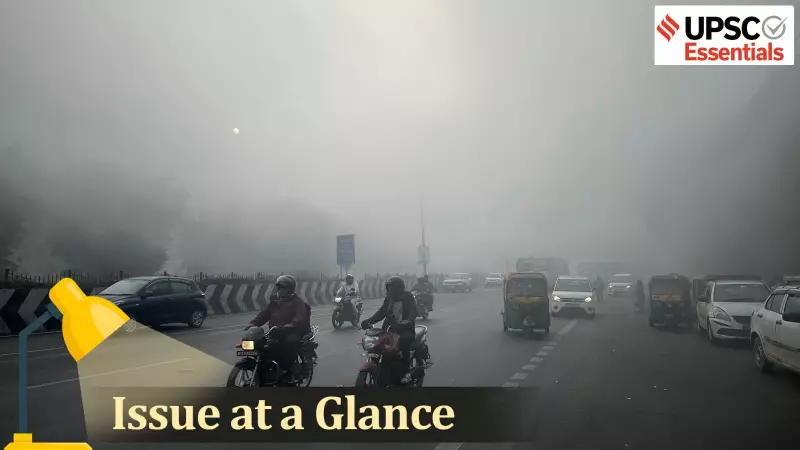
As the Delhi-National Capital Region (NCR) continues to battle hazardous air quality levels each winter, this persistent environmental crisis demands a thorough understanding, especially for aspirants preparing for the Union Public Service Commission (UPSC) examinations. The issue transcends seasonal headlines, embedding itself into the region's public health, economy, and policy framework.
The Anatomy of a Pollution Crisis: Sources and Culprits
Air pollution is defined as the contamination of the indoor or outdoor environment by chemical, physical, or biological agents that modify the natural characteristics of the atmosphere. According to the World Health Organization (WHO), a staggering 99% of the global population breathes air that exceeds WHO safety limits for pollutants.
The sources contributing to India's, and particularly North India's, degraded air are multiple and interlinked. Vehicular emissions stand as a primary contributor. Data from the Indian Institute of Tropical Meteorology's Decision Support System indicates that transport accounts for over 20% of PM2.5 emissions in Delhi during winter. The Commission for Air Quality Management (CAQM) notes that of the 2.88 crore vehicles in Delhi-NCR, 93% are light motor vehicles and two-wheelers, with about 37% being older, high-polluting Bharat Stage (BS) III or earlier models.

Industrial pollution from thermal power plants and factories adds a steady stream of sulfur dioxide (SO2) and nitrogen oxides (NOx). However, the post-harvest practice of stubble burning in neighboring Punjab and Haryana acts as a major seasonal accelerant, releasing vast quantities of particulate matter, carbon monoxide, and other toxins that push air quality to emergency levels.
Why the North Bears the Brunt: Geography and Climate
A critical question is why northern cities like Delhi, Lucknow, and Varanasi consistently report worse air quality compared to their southern and western counterparts such as Chennai, Mumbai, or Bengaluru. The answer lies heavily in geography and meteorology.
Northern India's Indo-Gangetic Plain is landlocked and hemmed in by the Himalayas to the north. This topography acts as a basin, trapping pollutants and preventing their dispersion. During winter, the phenomenon of temperature inversion worsens the situation. Cooler, denser air gets trapped near the surface under a layer of warmer air, creating an atmospheric 'lid' that severely limits vertical mixing and allows pollutants to accumulate.
In contrast, coastal cities benefit from stronger winds and sea breezes that help disperse pollutants. The summer monsoon also provides a cleansing effect for the north, but the winter months create a perfect storm of stagnant air and high emissions.
Devastating Impacts: Health, Economy, and Environment
The consequences of breathing toxic air are profound and far-reaching. The WHO attributes nearly seven million deaths worldwide annually to indoor and outdoor air pollution. A 2021 study in The Lancet Planetary Health found that air pollution was responsible for 1.67 million deaths in India in 2019 alone—about 17.8% of all deaths that year.
Health impacts range from aggravated asthma, lung disease, and strokes to increased cancer risk. Vulnerable groups like children, whose lungs and immune systems are developing, and the elderly, with naturally declining lung function, suffer disproportionately. Emerging research also points to links with cognitive development issues in children, exacerbated diabetes, and mental health problems.
The economic toll is equally severe. A World Bank report estimated the global cost of health damage from air pollution at $8.1 trillion annually, or 6.1% of global GDP. In India, pollution lowers labor productivity, reduces consumer footfall in services, hampers asset productivity, and leads to massive welfare losses and increased healthcare expenditures.
Government Initiatives and the Path Forward
The Indian government has launched several initiatives to combat this crisis. The cornerstone legislation is the Air (Prevention and Control of Pollution) Act of 1981. Key programs include:

The National Clean Air Programme (NCAP): Launched in 2019, it aims to reduce PM10 concentrations by 40% or achieve the national standard of 60 µg/m³ in 131 cities by 2025-26.
Graded Response Action Plan (GRAP): Implemented by the CAQM, it outlines escalating measures to prevent PM levels from exceeding the 'moderate' AQI category.
Air Quality Index (AQI): A color-coded public information tool launched in 2014, measuring pollutants like PM2.5, PM10, NO2, Ozone, and CO across six categories from 'Good' to 'Severe'.
Other measures include subsidies for crop residue management machinery, emission standards for thermal power plants, and promoting paddy straw-based pelletization plants.
Despite these efforts, experts recommend further action: a complete halt to municipal solid waste burning, accelerated promotion of electric and BS-VI vehicles, installation of De-SOx-ing and De-NOx-ing systems in power plants, mandatory covering of construction materials, universal access to LPG for cooking, and vapour recovery systems at petrol pumps.
For UPSC aspirants, this issue is critically relevant under General Studies Papers II and III, covering governance, environmental pollution, and policy interventions. A multidimensional understanding of air pollution—its science, socio-economic impact, and policy challenges—is indispensable for both the preliminary and mains examinations.