Residents of Delhi-NCR witnessed a marginal improvement in the choking smog on Wednesday, as stronger winds provided some relief. However, air quality across the region stubbornly remained in the 'very poor' category, with officials warning that the cleaner breath is likely to be fleeting.
Marginal Improvement in AQI Readings
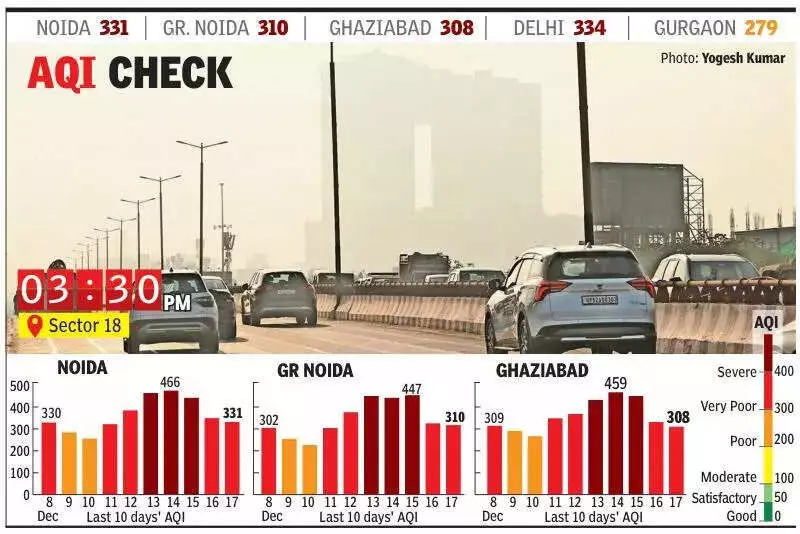
The air quality index (AQI) in Noida settled at 331, marking a noticeable but insufficient recovery from the previous four days when it hovered at 352, 437, 466, and 455. Neighbouring Greater Noida recorded an average AQI of 306 at 4 PM, while Ghaziabad stood at 304. The national capital, Delhi, also saw a slight easing, with its AQI dropping to 334 from 354 recorded a day earlier.
This minor reprieve came after the region endured nearly 72 hours in the 'severe' and 'severe-plus' categories starting December 13. The improvement was primarily driven by increased wind speeds, which picked up to around 15 kmph during the afternoon before slowing to about 10 kmph by evening, aiding in the dispersion of accumulated pollutants.

Fog Continues to Hamper Visibility and Travel
Despite the winds, a persistent layer of shallow fog continued to trap emissions and significantly reduce visibility. The India Meteorological Department reported visibility levels of 800 metres at Palam at 8 AM and 700 metres at Safdarjung, Delhi's base station, at 8:30 AM.
While these figures were better than previous days, air travel was severely disrupted. A total of 24 flights were cancelled and over 200 were delayed. An official explained that some cancellations were pre-emptive, while others resulted from low visibility conditions at other airports.
Forecast Warns of Deteriorating Conditions
The relief appears to be short-lived. The Air Quality Early Warning System for Delhi has forecast that pollution levels will remain in the 'very poor' category until December 20. More alarmingly, there is a significant risk of air quality deteriorating to the 'severe' category in the final week of December.
The Met department has predicted that shallow fog will continue to envelop the region until December 20, with moderate fog in isolated areas. It has also issued a yellow alert for moderate to dense fog on December 21 and 22, which could further worsen pollution by preventing the dispersal of harmful particles.
Station-Wise Breakdown and Enforcement Actions
Data from the Central Pollution Control Board revealed a grim picture at the local level. In Noida, three out of four monitoring stations recorded 'very poor' air. Sector 1 was the worst at 361, followed by Sector 125 (345) and Sector 116 (318). Only Sector 62, with an AQI of 300, fell in the 'poor' category.
In Greater Noida, Knowledge Park V recorded a 'very poor' AQI of 328, while Knowledge Park III was 'poor' at 291. Ghaziabad's Loni (327) and Sanjay Nagar (323) both reported 'very poor' air, with Indirapuram being slightly better at 273 ('poor'). Data from the Vasundhara station was unavailable.
Highlighting ongoing challenges in enforcement, the Uttar Pradesh Pollution Control Board in Noida took action against rampant violations of the Graded Response Action Plan (GRAP). It imposed fines totalling over Rs 3 lakh on six real estate developers for carrying out construction activities despite bans intended to curb pollution.
The collective data and official forecasts paint a clear picture: while Wednesday offered a brief respite, the toxic haze over Delhi-NCR is far from over, with conditions expected to become more hazardous in the coming days.