The air quality in Nagpur witnessed a slight improvement on Wednesday, moving back into the 'moderate' category overall. However, this marginal gain was overshadowed by alarming surges in harmful particulate matter during the night and early morning hours, continuing to cause significant concern among residents and authorities alike.
Night-Time Pollution Peaks Paint a Grim Picture
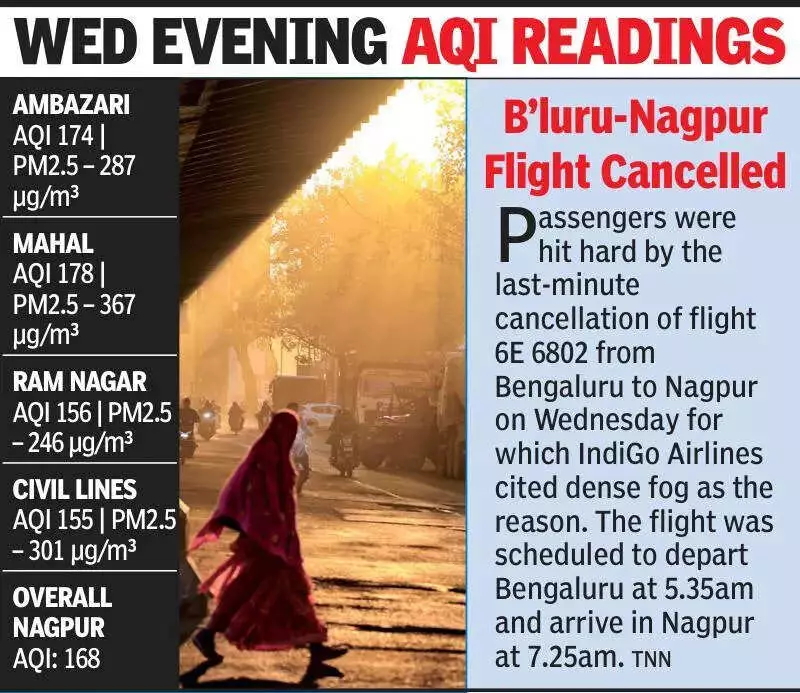
Despite the city's overall Air Quality Index (AQI) improving to 168, levels of the dangerous PM2.5 pollutant breached the critical 200 micrograms per cubic metre (µg/m³) mark across all major monitoring stations at various times. The data revealed stark local variations, with Mahal emerging as the worst-affected area, recording a terrifying peak PM2.5 concentration of 367 µg/m³.
Civil Lines followed with a peak of 301 µg/m³, and Ambazari recorded 287 µg/m³. Ram Nagar showed relatively lower levels, though its night-time PM2.5 still reached a high of 246 µg/m³. These spikes are far above safe limits, posing serious health risks, especially during the cold hours.

What's Causing the Dangerous Spikes?
Experts from the National Environmental Engineering Research Institute (Neeri) and Nagpur Municipal Corporation (NMC) officials have identified the primary culprits. They attribute the severe fluctuations not to industrial emissions, but to a combination of localised factors.
The main contributors include ongoing construction activities, road works, cement-related operations, and instances of open burning. Seasonal challenges like the winter inversion effect, where cold air traps pollutants close to the ground, and falling temperatures are exacerbating the situation. Officials also noted that the highly sensitive sensors at the city's Continuous Ambient Air Quality Monitoring Stations (CAAQMS) are accurately capturing these amplified night-time readings.
"The issue is multi-factorial," officials stated, pointing out that inter-seasonal changes typically push pollution levels higher during late December and early January. Similar peaks were documented in the first week of January this year.
Ongoing Investigations and Mitigation Efforts
To pinpoint the exact sources, teams of Neeri experts have begun an extensive field study. This includes daily site visits and detailed assessments within a 1 to 1.5-kilometre radius of each monitoring station. Past assessments have linked high readings near stations to nearby construction projects, road works, and even small-scale night-time activities like waste burning or using traditional stoves for heating water.
On the enforcement front, the NMC is conducting drives against open burning and violations related to construction and demolition (C&D) waste, with fines being levied where infractions are found. The civic body is also intensifying mechanical road sweeping and other dust-control measures.
A comprehensive source-apportionment study by Neeri, which will definitively identify pollution sources and their contributions, is expected to be completed and submitted by January next year. This report is anticipated to help fine-tune the city's air pollution mitigation strategies.
Until then, authorities have issued an advisory, urging citizens to avoid open burning completely and reduce outdoor exposure during late-night and early-morning hours, when pollution levels consistently surge. With limited industrial pollution, Nagpur's battle for cleaner air hinges on controlling these local, manageable sources.