The air quality in Nagpur has taken a severe hit, officially slipping into the 'poor' category. Data recorded between Monday night and Tuesday afternoon revealed alarming readings across the city's monitoring network.
Sharp Spike in Pollution Levels
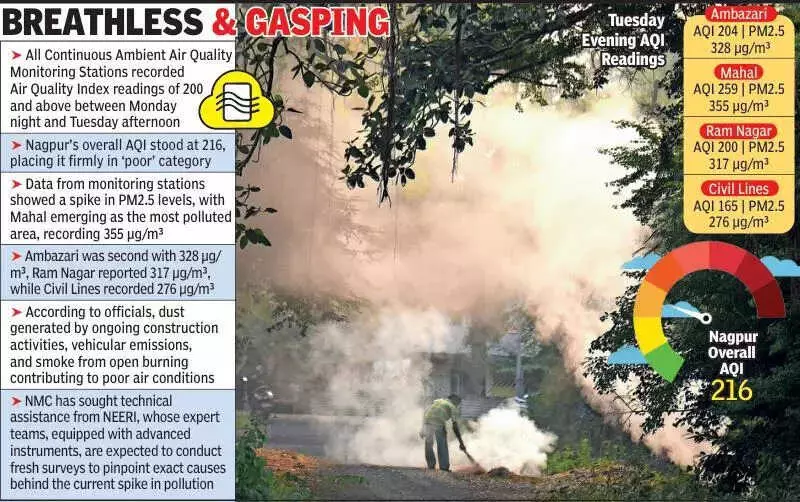
According to the latest bulletin from the Central Pollution Control Board (CPCB), Nagpur's overall Air Quality Index (AQI) stood at a concerning 216. All Continuous Ambient Air Quality Monitoring Stations (CAAQMS) in the city recorded AQI readings of 200 and above during this period, confirming the widespread nature of the problem.
The data pointed to a dangerous surge in fine particulate matter, specifically PM2.5. The area of Mahal emerged as the most polluted, recording a staggering PM2.5 concentration of 355 µg/m³. Other localities also showed critically high levels:

- Ambazari: 328 µg/m³
- Ram Nagar: 317 µg/m³
- Civil Lines: 276 µg/m³
An official from the Nagpur Municipal Corporation (NMC) noted that all major locations, except Civil Lines, crossed the 200 AQI mark, with Ambazari recording readings above 220 on Tuesday.
Causes and Official Response
Officials have attributed the sharp deterioration to a combination of factors. Dust from ongoing construction activities, vehicular emissions, and smoke from open burning are the primary culprits. These sources are exacerbated by typical winter conditions, where colder air and lower wind speeds trap pollutants close to the ground, preventing their dispersion.
"This is a recurring issue during winter when the settling of pollutants increases. Similar conditions were observed last year as well," an NMC official stated.
In response, the NMC's public health engineering department has initiated several measures. The civic body has intensified mechanical and manual road sweeping, dust suppression efforts, and monitoring of construction sites. Recognizing the persistent challenge, the NMC has once again sought technical assistance from the National Environmental Engineering Research Institute (NEERI). Expert teams from NEERI, equipped with advanced instruments, are expected to conduct fresh surveys to pinpoint the exact causes behind the current spike.
Health Warnings and Contributing Factors
The situation is further aggravated by the cold weather. On Tuesday, the city's minimum temperature dropped to 9.6 degrees Celsius, leading many residents to burn wood, tyres, and solid waste for warmth, which adds significantly to the toxic air.
Medical experts have raised serious concerns about the health implications. Paediatric Pulmonologist Dr. Vivek Charde warned that such pollution levels drastically increase allergic and respiratory diseases. It can worsen conditions like asthma, COPD, and allergic rhinitis, and cause eye and skin problems such as conjunctivitis and eczema.
"Pollutants can even affect unborn children by crossing the placenta, triggering inflammation before birth," Dr. Charde explained, emphasizing that children and the elderly are the most vulnerable during prolonged exposure to poor air quality.
Historical surveys conducted with NEERI's support indicate that Nagpur can experience over 30 days of poor air quality in December alone due to these seasonal factors, highlighting a pattern that demands sustained action.