Just weeks after India celebrated significant progress in its fight against HIV, new data exposes a persistent and growing challenge: a rising number of patients are abandoning their life-saving treatment. Information obtained through the Right to Information (RTI) Act reveals thousands are being lost to follow-up each year, threatening to undermine the national program's gains.
Alarming Numbers: A National Concern
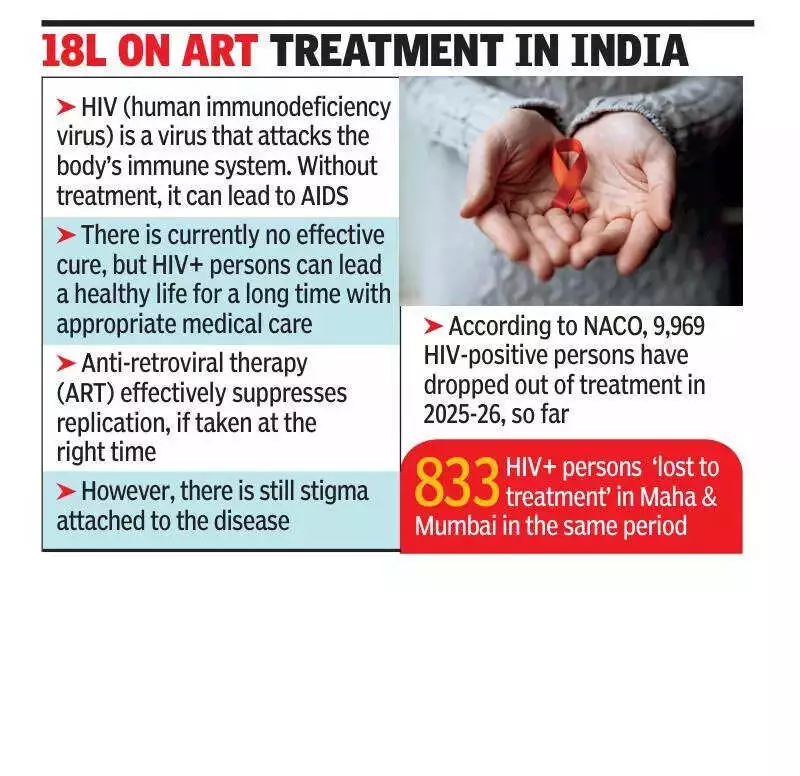
The data, acquired by Mumbai resident Chetan Kothari from the National AIDS Control Organisation (NACO), paints a concerning picture. In the financial year 2024-25, a staggering 20,312 people living with HIV (PLHIV) dropped out of treatment or were classified as "lost to treatment." For the current financial year 2025-26, the figure already stood at 9,969 by September 30.
This trend is particularly visible in Maharashtra, a historic hotspot for HIV/AIDS. The state recorded 833 patients lost to treatment in 2025-26 till September 30. While the state uniquely has two AIDS control bodies—the Mumbai District AIDS Control Society (MDACS) and the Maharashtra State AIDS Control Society (MSACS)—both are grappling with the issue.

Post-Pandemic Reversal of a Positive Trend
Officials noted that dropout rates had actually decreased during the peak COVID-19 pandemic years. Maharashtra saw 1,045 dropouts in 2020-21, which fell to 1,000 the following year. However, this trend has sharply reversed. The numbers climbed to 1,214 in 2022-23, and further increased to 1,290 in 2023-24 and 1,450 in 2024-25.
An MDACS official pointed to migration as a key factor in Mumbai's case. "We usually have 100-200 patients lost to treatment annually," the official said. "On follow-up, we find most are migrants who returned to their hometowns after receiving treatment in Mumbai for a few years."
Why Treatment Adherence is Critical
Experts stress the severe implications of this dropout rate. Dr. Ishwar Gilada of the People's Health Organisation called the trend "worrisome for any health programme," especially for HIV where the national programme provides free anti-retroviral treatment (ART) and tests.
ART is crucial as it suppresses the human immunodeficiency virus (HIV), keeps the viral load in check, and allows individuals to lead healthy lives. According to NACO, India has over 2.5 million people living with HIV, of whom 1.8 million are on ART. Patients are required to collect medicines from designated centres quarterly and undergo viral load testing.
NACO's own data from December 16 indicates roughly 1% of patients are lost to treatment annually. To combat this, agencies like MDACS conduct special drives to trace those who miss their appointments. "We call the person three times over three months before declaring them 'lost to follow-up'," explained an official. Efforts are also made to coordinate with other state AIDS control societies to trace patients who may have relocated.
The rising dropout numbers highlight a critical gap between providing treatment and ensuring its continuation, a challenge that requires renewed focus to sustain India's hard-won progress against HIV/AIDS.