

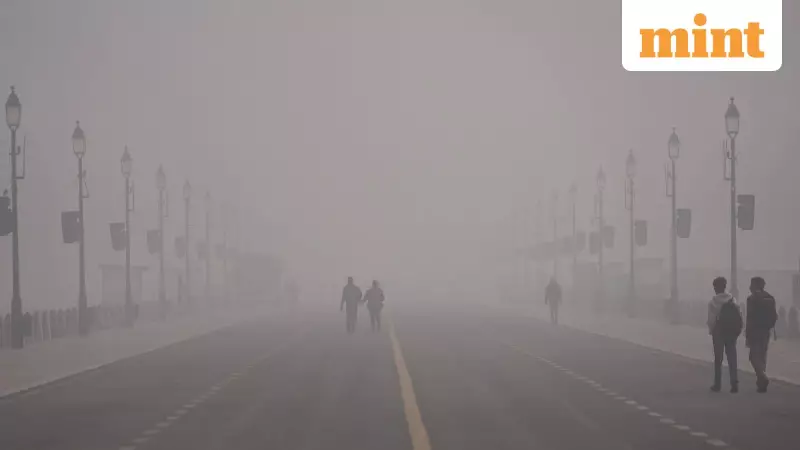
Delhi residents on Thursday, 18 December 2025, woke up to a dense, toxic haze as the city implemented a fresh set of stringent anti-pollution measures. The new restrictions come into force amid persistently 'severe' air quality levels recorded at multiple locations across the National Capital Region.
Government Announces Stricter Measures to Combat Pollution
In response to the deteriorating air quality, Delhi Labour Minister Kapil Mishra announced on Wednesday that all government and private offices in the city must operate with only 50% staff attendance in person. The remaining employees are mandated to work from home, effective from Thursday. Minister Mishra warned of action against offices failing to comply with this directive.
However, this order provides exemptions for essential and frontline workers. Employees in hospitals, fire departments, air pollution control teams, public and private health services, transport, sanitation, and other critical services are not required to follow the work-from-home rule.

In a relief measure for daily wage earners, the government also announced compensation. Construction workers affected by the ongoing GRAP Stage 3 restrictions, which have halted construction for the past 17 days, will receive ₹10,000. Minister Mishra stated that similar compensation would be provided for the duration of GRAP Stage 4, but only for workers registered with the government.
Traffic and Fuel Restrictions Take Center Stage
In a significant move to curb vehicular pollution, Delhi Environment Minister Manjinder Singh Sirsa declared that from Thursday, petrol pumps will not provide fuel to any vehicle without a valid Pollution Under Control (PUC) certificate. This certificate is issued after an emission check at authorized centers.
Furthermore, aligning with a recent Supreme Court modification of its earlier order, non-BS-VI compliant vehicles are now banned from entering the national capital. This effectively bars older, more polluting vehicles. Minister Sirsa specifically appealed to people entering Delhi to use only BS6-standard vehicles.
Adding to the transport curbs, trucks carrying construction materials into Delhi have also been prohibited. To enforce these new rules, teams from the Delhi Traffic Police and the transport department have been deployed at petrol pumps and the city's borders since Thursday morning.
AQI Status and Broader Restrictions
The Commission for Air Quality Management invoked these additional measures after Delhi's average Air Quality Index (AQI) remained in the 'severe' category for three consecutive days. While the city's overall AQI at 7:00 AM on Thursday was recorded at 358 ('very poor'), several areas continued to suffer 'severe' pollution levels.
According to Central Pollution Control Board (CPCB) data, locations like Anand Vihar, Jahangirpuri, Vivek Vihar, and Wazirpur were among the worst affected. These fresh restrictions are in addition to the existing Graded Response Action Plan (GRAP) Stage 4 protocols already in effect.
Earlier in the week, Delhi schools had already shifted to a hybrid mode of learning. The Directorate of Education (DoE) had ordered all primary classes to move completely online from Tuesday, 16 December.
The collective aim of these sweeping measures is to urgently reduce the toxic burden on Delhi's air and protect public health during this critical period of environmental crisis.






