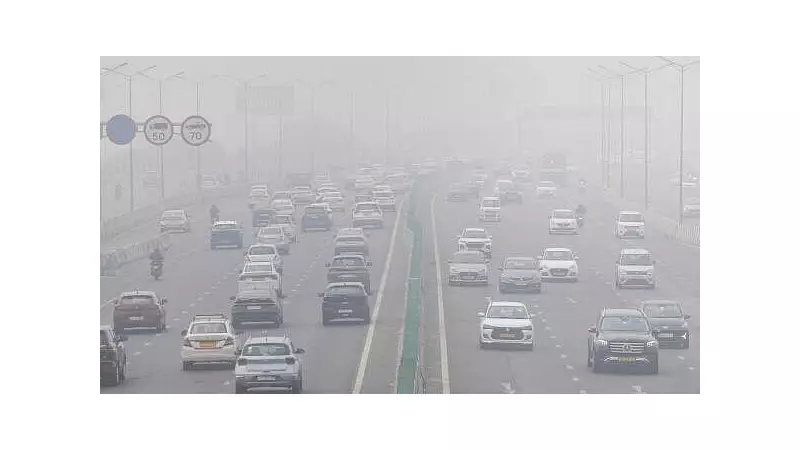
Delhi's battle against hazardous air has intensified as the city's air quality index (AQI) stubbornly remained in the 'Very Poor' category on Saturday. In response, the Commission for Air Quality Management (CAQM) has directed the immediate implementation of stringent Stage III measures under the Graded Response Action Plan (GRAP).
What Triggered the Strict Measures?
The decision followed a careful review of the air quality situation and meteorological forecasts. The sub-committee of the CAQM noted that Delhi's overall AQI was recorded at 346 on Saturday, which falls squarely within the 'Very Poor' band. Furthermore, forecasts from the India Meteorological Department and the Indian Institute of Tropical Meteorology indicated that weather conditions are likely to be highly unfavorable for the dispersion of pollutants over the next few days.
This combination of persistently poor air and an unpromising weather outlook forced the authorities' hand. The Stage III actions, also known as the 'Severe' category, are designed to prevent further deterioration when the AQI is predicted to cross the 400 threshold into the 'Severe' category.

Key Restrictions Under GRAP Stage III
The newly enforced restrictions target major known sources of pollution. A significant move is the immediate ban on all construction and demolition activities across the entire National Capital Region (NCR). However, this sweeping prohibition comes with essential exceptions. Critical projects related to railways, metro services, airports, defense, and hospitals are exempted. So too are projects of national security importance and linear public undertakings like highways and roads.
Another major clampdown is on road traffic. The CAQM has ordered a strict ban on the plying of BS-III petrol and BS-IV diesel four-wheelers in Delhi and the adjoining districts of Gurugram, Faridabad, Ghaziabad, and Gautam Budh Nagar. This measure directly targets vehicular emissions, a primary contributor to the city's winter pollution.
Other enforced measures include a step-up in mechanized road cleaning and water sprinkling to suppress dust, and a firm directive to state governments in the NCR to impose strict bans on the use of coal and firewood in eateries and restaurants.
The Larger Context and Public Advisory
This enforcement comes at a time when Delhi and its surrounding regions are grappling with the annual winter pollution crisis. The CAQM has also advised the public to limit outdoor activities and avoid travel via private vehicles as much as possible. The emphasis is on using public transport and carpooling to collectively reduce the emission load.
The commission has urged state governments to consider additional emergency steps like closing schools, implementing odd-even vehicle schemes, and halting non-essential government office operations. These decisions, however, are left to the discretion of the respective state administrations based on the severity of the situation in their areas.
The immediate future looks challenging. With winds expected to remain calm and temperatures dropping, pollutants are likely to accumulate near the ground. The success of these measures now hinges on strict enforcement and public cooperation to navigate through this period of critically poor air quality.