

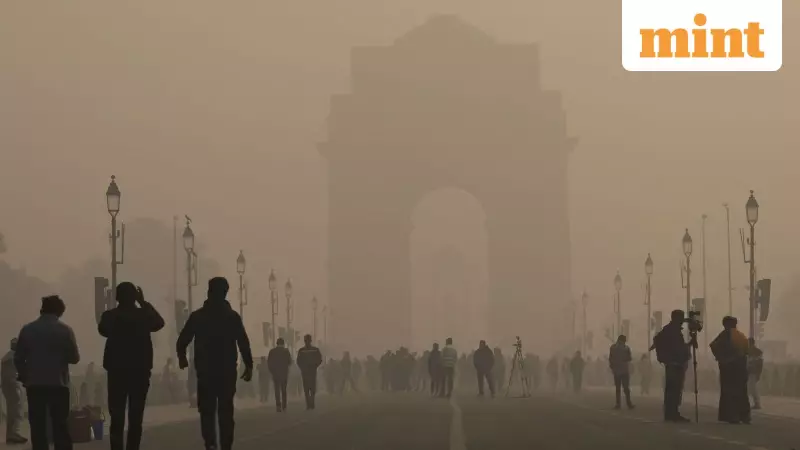
Delhi residents woke up to another day of hazardous air and severely reduced visibility on Wednesday morning as a toxic cocktail of smog and dense fog enveloped the national capital. Major landmarks and traffic arteries disappeared under a thick, grey haze, creating dangerous conditions for commuters and raising serious health alarms.
Pollution Data Paints a Grim Picture
Official data from the Central Pollution Control Board (CPCB) revealed the severity of the crisis. At the Anand Vihar monitoring station, the Air Quality Index (AQI) was recorded at a worrying 341. The situation was even worse near the ITO area, where levels spiked to 360. Both readings fall firmly within the "very poor" category according to the national AQI scale.
Out of the 39 active air quality stations across Delhi, a staggering 35 reported 'very poor' air. One location, Mundka, entered the 'severe' zone with an AQI of 407. While stronger winds had provided a slight respite on Tuesday, the reprieve was tragically short-lived.

Emergency Measures and Travel Chaos
In response to the persistent emergency, the Commission for Air Quality Management (CAQM) has enforced all measures under Stage IV of the Graded Response Action Plan (GRAP) across Delhi-NCR. These stringent steps include major curbs on construction, industrial activities, and the movement of certain types of vehicles.
The foul air combined with dense fog severely hampered visibility, leading to major disruptions in air travel. Anticipating the problem, IndiGo airline issued a travel advisory on Tuesday night. The airline warned passengers of likely delays and adjustments to flight schedules due to reduced visibility across North and East India.
"Our teams across airports are fully prepared and working in close coordination to manage schedules smoothly," the airline stated, while advising travellers to check their flight status and plan for extra time on roads, which were also affected.
Health Experts Sound the Alarm, Especially for Children
Medical professionals have issued stark warnings about the immediate health impacts of such severe pollution. Dr. Medha, a paediatrician at Madhukar Rainbow Children's Hospital, highlighted the grave danger for infants.
She explained that infants breathe faster than adults relative to their body weight, leading to higher exposure to deadly pollutants like PM2.5. These fine particles can penetrate deep into developing lungs and even enter the bloodstream.
"Frequent exposure is increasingly being linked to recurrent cough, wheezing, breathlessness, and conditions like bronchiolitis in infants," Dr. Medha said. She added that continuous exposure weakens immune defences, making young children more susceptible to pneumonia and other respiratory infections.
The forecast offers little hope for a quick cleanup. The Centre's Air Quality Early Warning System for Delhi predicts that air quality will likely remain in the 'very poor' category until Friday. From December 19 onwards, conditions may fluctuate between 'very poor' and 'severe', indicating a prolonged period of health risk for the city's inhabitants.






