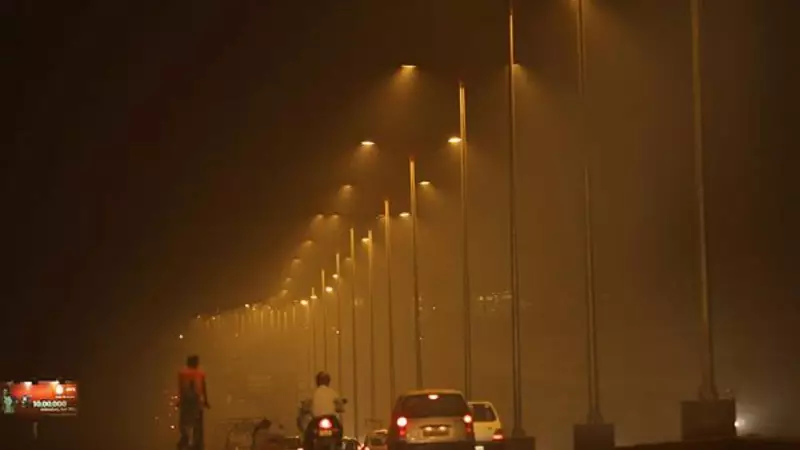
Delhi residents woke up to another day of severe air crisis on November 24, 2025, as the capital's air quality index soared to hazardous levels, creating a public health emergency across the National Capital Region.
Severe Pollution Grips Delhi-NCR
According to data from private air quality tracker AQI.in, Delhi's air quality reached alarming levels with the AQI pegged at 559 on Sunday, placing it firmly in the hazardous category. However, there was significant discrepancy in readings as the government's Air Quality Early Warning System recorded a lower but still dangerous AQI of 397.
The visual evidence was unmistakable across the city with thick smog blanketing the entire skyline, reducing visibility to the point where buildings and roads became barely recognizable from a distance. The situation was particularly dire in several neighborhoods that recorded even higher pollution levels.

Health Impact Equivalent to Heavy Smoking
The health implications of breathing Delhi's current air are staggering. Data from AQI.in reveals that exposure to this level of pollution is equivalent to smoking 11.8 cigarettes per day. This alarming comparison is based on the average PM2.5 concentration over the past 24 hours, assuming continuous exposure during that period.
The PM2.5 concentration measured on Monday reached 331 µg/m³, which is 22.06 times higher than the World Health Organization's safe limit of 15 µg/m³. According to WHO guidelines, prolonged exposure to such high levels of PM2.5 can lead to serious cardiovascular and respiratory diseases, including stroke, lung cancer, and chronic obstructive pulmonary disease.
Worst-Affected Areas and Government Response
Several areas across Delhi recorded exceptionally dangerous air quality levels. Maidan Garhi topped the list with AQI at 734, followed by Ashok Vihar at 702, West Sant Nagar Burari at 629, Surya Nagar at 595, Vasant Vihar at 519, and Vasant Kunj at 497.
The pollution crisis extended beyond Delhi to neighboring cities in the National Capital Region. Greater Noida recorded an AQI of 607, while Ghaziabad stood at 536, Noida at 529, and Gurugram at 406, indicating a regional environmental emergency.
In response to the deteriorating situation and following Supreme Court observations, the Commission for Air Quality Management has tightened Delhi-NCR's pollution-response framework. The revised Graded Response Action Plan now activates several measures at lower pollution thresholds than before.
Key changes include implementing staggered office timings, expanding public transport services, and enabling work-from-home options when air quality enters the Poor category (200-300 AQI), rather than waiting for it to reach Very Poor levels as was previously the case.
Health Advisory and Protective Measures
Medical experts and authorities have issued urgent health advisories for Delhi residents:
Minimize outdoor exposure as much as possible and wear N-95 masks whenever venturing outside. All outdoor physical activities, including jogging, running, and yoga, should be avoided completely.
Schools across the city have already suspended outdoor activities and sports to protect children's health. Residents are advised to use air purifiers at home and in vehicles whenever available and to seek immediate medical attention if they experience any breathing difficulties or respiratory symptoms.
The six AQI categories range from Good (0-50) and Satisfactory (50-100) to Moderately polluted (100-200), Poor (200-300), Very Poor (300-400), and Severe (400-500). Any reading above 500 is classified as Hazardous, representing an extreme health risk to the entire population.