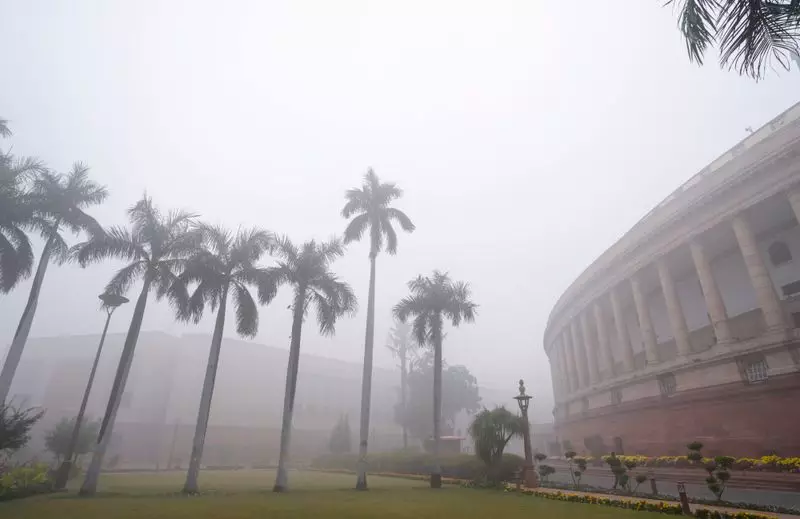
Residents of India's capital breathed a little easier on Monday as the city's notorious air pollution showed a marginal improvement. The overall Air Quality Index (AQI) for Delhi settled at 377, according to the latest data from the System of Air Quality and Weather Forecasting and Research (SAFAR). This reading falls squarely within the 'Very Poor' category, as defined by the Central Pollution Control Board (CPCB).
A Gradual Dip in Pollution Levels
The recorded AQI of 377 on Monday marked a slight but welcome decline from the previous day's reading of 395, which was also classified as 'Very Poor'. This data, compiled by the prominent forecasting body SAFAR, indicates a tentative positive trend. The AQI scale categorizes readings between 301 and 400 as 'Very Poor', a level where prolonged exposure can lead to respiratory illness for the general population.
While the improvement is modest, it offers a brief respite from the more severe conditions often witnessed in the National Capital Region (NCR) during the winter months. The shift suggests that a combination of meteorological factors and ongoing pollution control measures may be having a minor, temporary effect.

Understanding the 'Very Poor' Category and Health Implications
The Central Pollution Control Board's classification system is designed to inform the public about health risks. An AQI in the 'Very Poor' range, from 301 to 400, comes with a clear health advisory. Authorities warn that such air quality can trigger respiratory issues even in healthy individuals upon prolonged exposure.
The recommended precautions for this category include:
- Avoiding prolonged or heavy outdoor physical activity.
- People with heart or lung diseases, older adults, and children should remain indoors and restrict all outdoor exertion.
- Using N95 or P100 masks when going outside becomes necessary.
The persistent 'Very Poor' air quality underscores the chronic nature of Delhi's pollution crisis, which stems from a complex mix of vehicle emissions, industrial pollution, construction dust, and seasonal agricultural burning in neighboring states.
Monitoring and the Path Ahead
The daily AQI readings are a critical tool for both citizens and policymakers. Data from agencies like SAFAR and the CPCB help track the effectiveness of Graded Response Action Plan (GRAP) measures and other interventions. The slight dip to 377, while not a dramatic recovery, is a data point that environmental bodies will analyze in the context of wind patterns, temperature, and enforcement of pollution norms.
The forecast for the coming days remains crucial. Experts closely monitor whether this marginal improvement will sustain or if conditions will deteriorate back into the 'Severe' category (AQI 401-500), which brings with it more stringent restrictions and graver health warnings. Continuous monitoring and proactive, long-term strategies are essential for the capital to achieve lasting clean air.
For now, Delhi's air quality, though still hazardous, has taken a small step away from the brink of 'Severe' levels. The city continues its struggle for cleaner air, with every minor fluctuation in the AQI being watched closely by millions of its inhabitants.