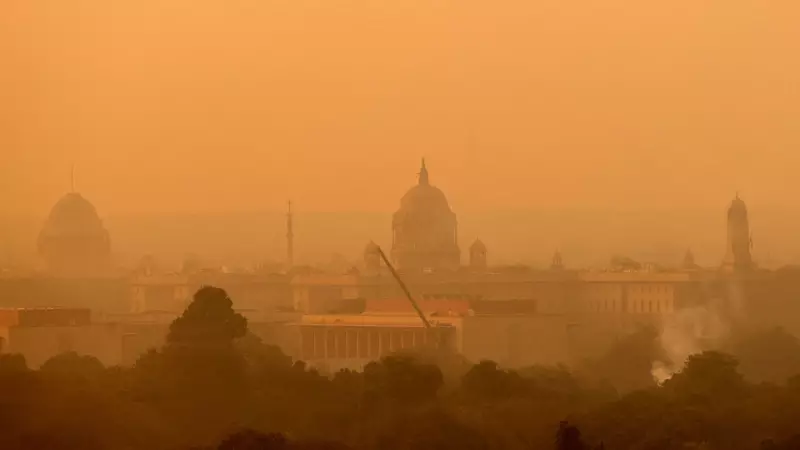
On Tuesday, Delhi's air quality deteriorated further, with the Air Quality Index (AQI) rising to 374 from 351 the previous day, firmly placing the capital in the 'very poor' category. This alarming spike prompted a significant gathering of students, activists, and residents at Jantar Mantar, who staged a protest demanding their fundamental right to breathable air and life.
Voices from the Ground: Gas Masks and RTIs
The protest, which occurred just nine days after demonstrators were detained at India Gate, saw participants armed with placards and symbolic props like gas masks. They emphasized that the situation requires a serious, long-term response from the authorities.
One protester, Atul, who had moved to Delhi from Prayagraj in 2021, made a striking statement by wearing a gas mask connected to a canister containing a potted plant. "I have been living in Delhi since 2021... In the last four years I have seen the air getting worse and worse here," he stated, expressing his fear that clean air might become a commercial commodity, much like bottled water.

Adding a legal dimension to the demonstration, young lawyer Shubham Gupta distributed RTI forms with 21 pointed questions for the government. He argued that with the BJP now in power at multiple levels—including Haryana, Uttar Pradesh, Delhi, the MCD, and the NDMC—there is no one else left to blame for the inaction. "The BJP rules Haryana, Uttar Pradesh, Delhi, the MCD and the NDMC," Gupta said, while clarifying that the protest was not politically motivated and that he would not shift blame from Punjab either.
The Stark Reality of Pollution Data
The data from the Central Pollution Control Board (CPCB) painted a grim picture, not just for Delhi but for the entire National Capital Region (NCR). While Delhi's AQI was 374, the situation was even more severe in neighboring areas. Greater Noida and Ghaziabad reported 'severe' air quality with AQI levels of 454 and 434, respectively.
According to the Decision Support System (DSS) by the Indian Institute of Tropical Meteorology (IITM), transport emissions were the single largest contributor to particulate matter pollution in Delhi, accounting for 18.15%. Other significant sources included pollution drifting in from neighboring regions like Ghaziabad (5.95%) and Gautam Buddha Nagar (4.85%). The share of farm fires in Delhi's pollution was 5.43%, while residential emissions contributed 4.6%.
On the day of the protest, the Indian Agricultural Research Institute reported 1,104 stubble burning events across six states, with Madhya Pradesh (641) and Uttar Pradesh (377) leading the count, followed by Rajasthan (65), Punjab (15), and Haryana (6).
Health Impacts and a Call for Policy Action
For the protesters, the issue was deeply personal, with many sharing the health toll of the toxic air. Ranvijay, a PhD student, reported that frequent headaches have become a common complaint among his peers. "I have also had headaches and whenever I go to the doctor... they say it is because of the pollution and ask us to wear a mask," he shared.
However, he and others saw masks as a woefully inadequate solution. They called for robust policy-level interventions, such as increasing public transport, reinstating the odd-even vehicle scheme, and implementing stricter controls on industrial pollution. "We are asking for our right to life from a political entity — the government — while conducting a political activity: a protest. Everything is political," Ranvijay concluded, encapsulating the sentiment of the gathering.
The protest was also galvanized by a recent statement from the Supreme Court. One college student, who wished to remain anonymous, explained that they were waiting for the apex court to speak. "After yesterday's statement by CJI Gavai, we all thought that it must be followed with a protest to show the government that clean air is a demand of the citizens," the student said. With the IITM predicting that the 'very poor' air quality will persist, the demand for action is only growing louder.