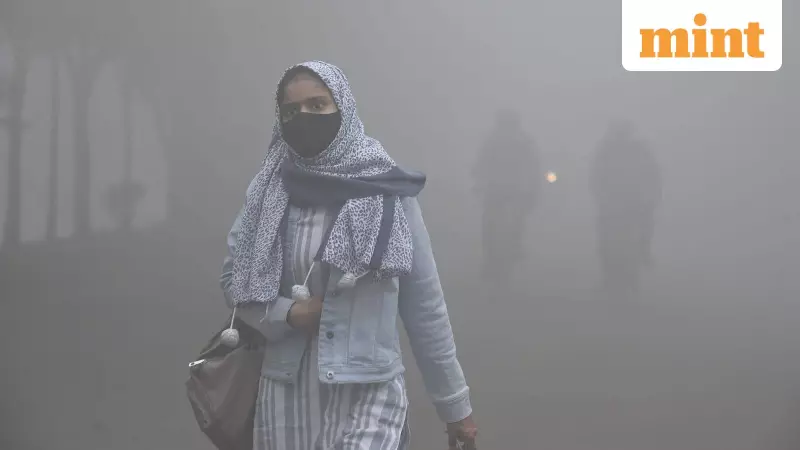
As winter tightens its grip on the national capital, a thick blanket of smog has descended upon Delhi, significantly reducing visibility and plunging air quality into the 'very poor' category. Residents woke up to hazy skies on Sunday morning, with the Central Pollution Control Board (CPCB) recording an overall Air Quality Index (AQI) of 365 at 7 am.
Widespread Poor Air Across Monitoring Stations
The alarming pollution levels were widespread across the city. Data from the pollution control board revealed a grim picture: out of Delhi's 39 air-monitoring stations, a staggering 26 recorded pollution levels in the 'very poor' range. The remaining 13 stations reported air quality in the 'poor' category.
Several key locations reported critically high pollution readings. These included:

- Rohini (AQI 341)
- Bawana (AQI 352)
- Wazirpur (AQI 337)
- RK Puram (AQI 326)
- Anand Vihar (AQI 327)
- Punjabi Bagh, Chandni Chowk, and Sonia Vihar (all around AQI 320)
Areas that registered slightly lower, but still 'poor', air quality included Alipur (282), NSIT Dwarka (239), Mandir Marg (212), IGI Airport (227), and Aya Nagar (263).
A Week of Fluctuating, But Dangerous, Pollution Levels
The current smog situation is the result of a consistently poor air quality trend throughout the past week. Pollution levels have seen noticeable fluctuations, but have stubbornly remained in the hazardous zones.
The city's AQI was recorded at 279 last Sunday, climbing to 304 on Monday. It peaked sharply at 372 on Tuesday before settling at 342 on Wednesday. The air quality remained in the 'very poor' category on Thursday (304) and Friday (327), setting the stage for the current smog episode.
According to CPCB's standards, an AQI between 301 and 400 is classified as 'very poor', which can trigger respiratory illness on prolonged exposure. Readings between 201 and 300 are considered 'poor'.
Identifying the Major Pollution Contributors
Analysis from the Decision Support System for Delhi has pinpointed the key contributors to the toxic air. Local transport emissions within Delhi were identified as the largest single source, contributing 14.8% to the pollution load.
Industrial activity, both within the capital and in the surrounding National Capital Region (NCR), accounted for 7.3% of the emissions. Residential sources and construction activities contributed 3.6% and 2% respectively.
The data also highlighted the significant impact of neighbouring districts. Jhajjar in Haryana contributed a substantial 13.9% to Delhi's pollution, while Rohtak added another 5.2%, underscoring the regional nature of the air quality crisis.
Cold Weather Conditions Add to the Discomfort
Compounding the pollution problem is the ongoing winter chill. The India Meteorological Department (IMD) had issued a 'Yellow Alert' for coldwave conditions in Delhi on Friday. Although this alert was lifted by Sunday, cold conditions persisted with the minimum temperature expected to drop to around 9 degrees Celsius.
The daytime high is likely to reach nearly 25 degrees Celsius under partly cloudy skies. The combination of cold, stagnant air and high pollution levels is creating a serious public health concern, with authorities urging vulnerable groups to take necessary precautions.