

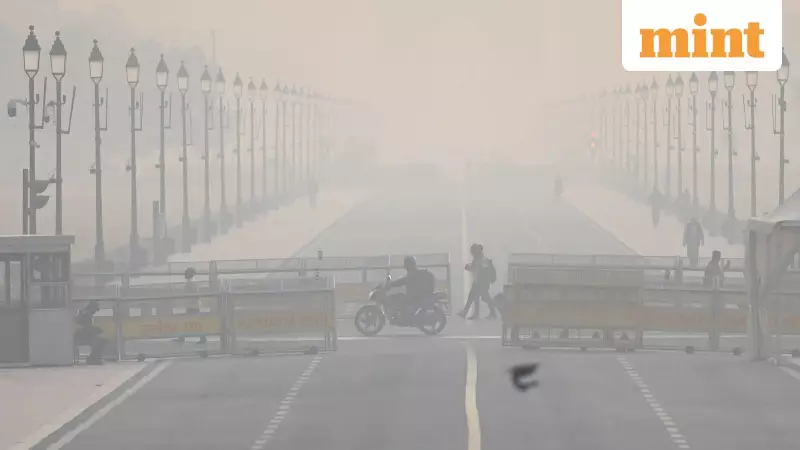
Delhi's Air Quality Crisis Intensifies
The national capital continues to grapple with dangerously polluted air as residents woke up to another day of hazardous conditions on Wednesday, November 19. According to the Central Pollution Control Board (CPCB), Delhi's average Air Quality Index (AQI) stood at 386 at 5:30 AM, firmly placing it in the 'very poor' category.
The situation has remained stagnant over the past several days since pollution levels entered the 'severe' range last week. This persistent environmental emergency has prompted authorities to implement Stage 3 restrictions of the Graded Response Action Plan (GRAP) as directed by the Commission for Air Quality Management (CAQM).
Multiple Locations Cross Dangerous Threshold
Data from air quality monitoring stations across Delhi-NCR revealed alarming figures, with 16 out of 30 locations registering AQI readings in the 'severe' category, meaning they exceeded the 400 mark on the 500-point measurement scale.

Wazirpur emerged as the worst-affected area with an AQI of 446, closely followed by Bawana at 444 and Jahangirpuri at 442. Several other prominent locations recorded similarly dangerous levels, including Chandni Chowk, Ashok Vihar, DTU, and Vivek Vihar, all falling within the 430-440 AQI range.
The CPCB's Sameer app indicated additional areas suffering from severe air quality, including Sonia Vihar, Rohini, RK Puram, Punjabi Bagh, North Campus, Nehru Nagar, Narela, Mundka, and Anand Vihar.
Regional Impact and Preventive Measures
The pollution crisis extends beyond Delhi's boundaries, affecting neighboring regions with varying intensity. Greater Noida recorded the highest regional AQI at 450, while Noida stood at 410 and Ghaziabad at 435. Faridabad and Gurugram showed relatively better conditions with AQI readings of 234 and 288 respectively.
In response to the escalating situation, authorities have enforced several pollution control measures under GRAP Stage 3 restrictions. These include a complete ban on construction activities, mandatory sprinkling of water on roads to settle dust particles, and restrictions on vehicular traffic across Delhi-NCR roads.
The alarming pollution levels have also impacted educational institutions, with primary classes across Delhi schools shifting to hybrid mode to protect young children from exposure to toxic air.
As the national capital continues to battle this environmental emergency, residents await significant improvements in air quality while adhering to the restrictions imposed by authorities.






