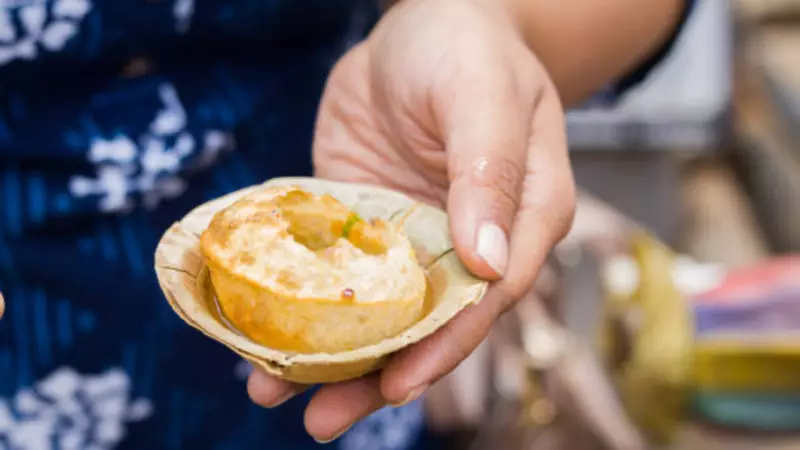
A routine evening snack of golgappa, or pani puri, turned into a painful ordeal for a woman in Auraiya, Uttar Pradesh, this week. The incident, which was captured on video and went viral, has left street food lovers across India shocked and concerned.
The Incident: A Snack Gone Wrong
While enjoying the popular roadside treat, the woman attempted to take a large bite of a generously stuffed golgappa. In that moment, her jaw dislocated, locking her mouth wide open and causing severe pain. Her family immediately rushed her to a local clinic. However, the doctors there were unable to reset her jaw, necessitating a referral to a larger hospital for specialized treatment.
The viral video of the incident serves as a stark reminder that even everyday activities like eating can sometimes lead to unexpected medical emergencies.

Medical Insight: How Can Eating Cause a Jaw to Dislocate?
To understand this unusual event, we consulted medical experts. Dr. Alok Thakar, Director of Head & Neck Cancer Thyroid & Parathyroid Surgery at Medanta Hospital, Noida, explains that a jaw dislocation occurs when the rounded end of the jawbone (the condyle) moves too far forward and gets stuck outside the temporomandibular joint (TMJ). This prevents the mouth from closing properly.
Dr. Ankit Parasher, Consultant ENT at Yatharth Super Speciality Hospital, Faridabad, adds that such dislocation can happen during ordinary actions like eating, yawning widely, or laughing hard. When the mouth is opened excessively, the ligaments and the cushioning disc within the TMJ can overstretch, causing the joint to become unstable and the jaw to lock.
"Foods that challenge you to take a big bite, like large golgappas, thick burgers, or wraps, can be a trigger," says Dr. Thakar. For individuals with naturally loose ligaments or a shallow TMJ socket, this extreme stretch can easily push the jawbone out of its joint.
Who is at Higher Risk?
Experts clarify that while such incidents are rare for the general population, certain individuals are more vulnerable.
Dr. Ankit Parasher identifies people with naturally flexible ligaments, those with conditions like Ehlers-Danlos Syndrome, and individuals with a history of TMJ dysfunction, arthritis, or previous jaw injuries as being at higher risk. Habitual teeth grinding or clenching can also weaken the joint over time.
Dr. Alok Thakar points out a genetic component, where joint flexibility or a shallow socket can run in families. He emphasizes that once a person has experienced a dislocation, the likelihood of it recurring increases significantly.
What to Do (and NOT Do) in Case of Jaw Dislocation
Both doctors stress that a dislocated jaw is a medical emergency that requires professional intervention.
The first and most crucial rule is: Do not try to force the jaw back into place yourself. Attempting a DIY reset can cause more damage, including fracturing the bone or injuring nerves and blood vessels.
Dr. Parasher advises heading straight to the nearest emergency room. A trained doctor will use a controlled technique to gently guide the jaw back into its socket, often after administering pain relief or mild sedation to relax the muscles. While waiting for help, applying a warm compress and supporting the jaw with hands can provide some comfort.
Dr. Thakar recommends keeping the mouth as stable as possible without applying force until medical professionals can assist.
Should You Stop Eating Golgappa?
The experts offer reassurance to street food enthusiasts. For the vast majority of people, enjoying golgappa is perfectly safe. The incident in Auraiya is an extreme rarity.
"Only a small group with pre-existing TMJ issues or hypermobility need to be extra cautious," states Dr. Parasher. The key takeaway is moderation and awareness of one's own body.
Dr. Alok Thakar concludes with simple advice: "Enjoy your golgappas, but avoid forcing your mouth open wider than its comfortable limit. Take manageable bites, chew comfortably, and there should be no reason for worry."