The recent ban on the Communist Party of Poland by that country's constitutional tribunal triggered an unexpected wave of nostalgia in Kerala. Social media flooded with memes featuring a classic line from the 1991 cult film Sandesham: "Polandinekurich oraksharam mindaruth" (don't say a word about Poland). This dialogue, delivered by the rigid Left ideologue Kottappally Prabhakaran, played by Sreenivasan himself, has endured for over three decades as a cultural shorthand for blind ideological loyalty.
The Architect of Satire in Malayalam Cinema
Much like Charlie Chaplin used comedy to critique industrialisation, Sreenivasan mastered satire as Malayalam cinema's most potent moral language. His work, layered with humour, consistently questioned power, middle-class pretence, political opportunism, and social decay. He achieved this not through grand spectacle, but by exploring the fragile lives of ordinary people.
Though trained in acting at Chennai's MGR Film Institute, Sreenivasan's genius truly flourished in writing. His creative universe was defined by a distinctive satirical voice and a profound grasp of social behaviour. Characters like the jealous husband Thalathil Dineshan in Vadakkunokkiyantram, the rationalist-turned-superstitious Vijayan in Chinthavishtayaya Shyamala, the struggling actor Saroj Kumar in Udayananu Tharam, and the aforementioned Kottappally Prabhakaran are celebrated for their psychological depth and enduring relevance.

Films That Defined Generations and Critiqued Society
His directorial debut, Vadakkunokkiyantram (1989), showcased a craftsman who could seamlessly blend humour with deep psychological insight. However, it was his collaborations and solo writing ventures that cemented his legacy.
In Sandesham, Sreenivasan dissected the dangers of mediocrity in politics, showing how party workers create false scandals, exploit martyrs' legacies, and reduce ideology to mere opportunism. The film's observations on Kerala's political culture remain strikingly accurate today.
Varavelpu (1989), directed by Sathyan Anthikad from Sreenivasan's script, followed a Gulf returnee's dream of starting a bus business, only to be crushed by trade unions and a ruthless bureaucracy. The film's relevance was nationally acknowledged in 2003 when Prime Minister Atal Bihari Vajpayee cited it as a cautionary tale about Kerala's economic environment.
His focus on Kerala's socio-economic realities continued through films like Pattanapravesham and right up to his final screenplay, Njan Prakashan (2018), which captured the desperation of educated youth through a protagonist who changes his name from Prakashan to P R Akash for better job prospects.
A Versatile Performer and Fearless Critic
As an actor, Sreenivasan displayed remarkable range, excelling in both comedic and dramatic roles. From the iconic duo in Nadodikkattu to the transformative role in Chinthavishtayaya Shyamala, and even memorable villain turns in Thenmavin Kombathu and Maravathoor Kanavu, he left an indelible mark. His comedy was never slapstick; it was intelligent, layered, and rooted in acute social observation.
Film critic C S Venkateswaran places Sreenivasan's writing on par with literary greats like VKN and Sanjayan. "He was a rare genius who relentlessly critiqued the hypocrisy in Malayali society's 'progressiveness'," Venkateswaran noted. "He was fearless in his satire, unmindful of hierarchy, and did not hesitate to target the powerful." The critic also highlighted that Sreenivasan's writing, despite being shaped in a male-dominated era, was never misogynistic.
Beyond satire, he skillfully handled intimate family dramas like Mazhayethum Munpe, Chambakkulam Thachan, and Maravathoor Kanavu with sensitivity. Director Kamal recalled Sreenivasan's uncompromising dedication, noting that leading actors would wait for years for his scripts due to their unwavering faith in his writing.

A Complex Relationship with Ideology
Born in Patyam, Kannur—a traditional Left stronghold—Sreenivasan initially took openly progressive stances. However, as his cinematic voice matured, he faced sustained criticism from sections of the Left, who accused his films of diluting political commitment and promoting an apolitical worldview through satire.
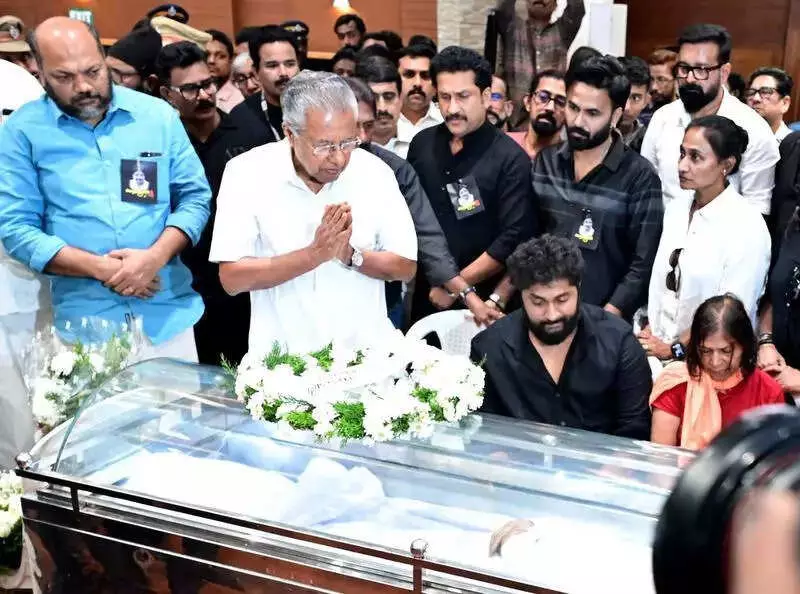
With his passing, Malayalam cinema has lost a singular voice that used humour not to escape politics, but to interrogate it. His films and characters continue to unsettle and entertain, holding up an honest, often uncomfortable, mirror to the Malayali psyche. The resonance of a line about Poland, three decades later, is a testament to the timelessness of his craft and his deep understanding of the society he portrayed.