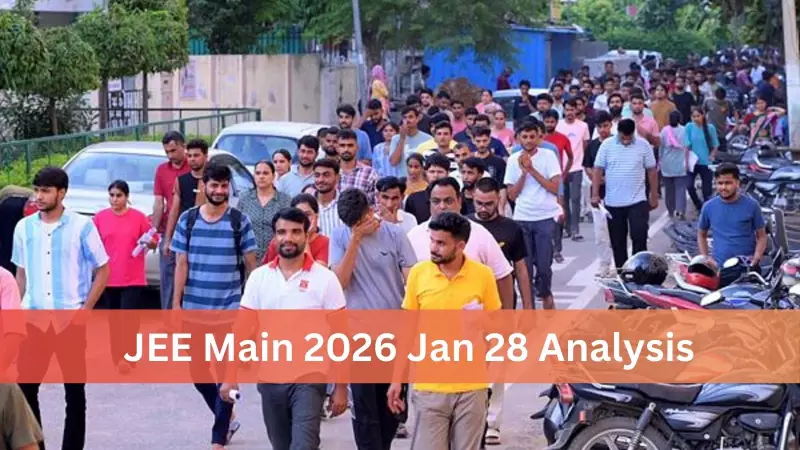
The National Testing Agency (NTA) successfully conducted the final day of the Joint Entrance Examination Main (JEE Main) 2026 Session 1 Paper 1 for BTech and BE aspirants on January 28, 2026. This crucial examination, held across two shifts from 9 am to 12 noon and 3 pm to 6 pm, marked the culmination of the January session for engineering hopefuls across India.
Exam Structure and Format
The JEE Main Paper 1, designed for BTech and BE admissions, encompassed three core subjects: Physics, Chemistry, and Mathematics, collectively carrying a total of 300 marks. Each subject was divided into two distinct sections to assess diverse problem-solving skills.
Sectional Breakdown
- Section 1: Comprised 20 multiple-choice questions with a single correct answer, testing conceptual clarity and quick decision-making.
- Section 2: Featured 5 numerical-based questions, emphasizing computational accuracy and step-by-step solving abilities.
Overall Paper Analysis: A Balanced Yet Challenging Affair
According to Ajay Sharma, National Academic Director for Engineering at Aakash Educational Services Limited, the morning shift paper on January 28 was rated as moderate to difficult in overall difficulty. Candidates reported that the paper was well-balanced in terms of question distribution and chapter coverage, ensuring a comprehensive assessment of the syllabus.

However, the Mathematics section emerged as the most demanding and time-consuming, posing significant challenges for test-takers. In contrast, Chemistry and Physics were perceived to be of nearly equal difficulty, with Chemistry leaning towards the easier side. The lengthy and calculation-intensive nature of the Mathematics questions made it particularly tough to complete the paper within the stipulated time frame.
Subject-Wise Detailed Analysis
Physics: Manageable and NCERT-Aligned
Experts unanimously described the Physics section as relatively easier to moderate. Ajay Sharma noted that questions were drawn from almost all major chapters, with a higher emphasis on electromagnetism. Optics and waves had fewer questions, while mechanics maintained an average representation.
Dr. Saurabh Kumar, Founder and CEO of Shiksha Nation, highlighted that the Physics paper was easy to moderate and heavily aligned with NCERT concepts. Most questions were formula-based, making this section highly scoring for well-prepared students. Key topics included Electrostatics and Capacitors, Current Electricity, Modern Physics, and Ray Optics. The numerical problems were straightforward, lacking complex calculations, allowing students to comfortably attempt 20 to 22 questions.
Chemistry: Straightforward and Concept-Driven
The Chemistry section was rated as easy to moderate by Sharma, with questions evenly distributed across organic, inorganic, and physical chemistry. A slight dominance of organic chemistry was observed, and many questions were statement-based, closely mirroring NCERT textbooks.
Kumar emphasized that Chemistry was easy overall, with a strong focus on NCERT-based content. Inorganic Chemistry proved particularly scoring due to direct, fact-based questions. Physical Chemistry featured straightforward numerical problems from topics like the mole concept and thermodynamics. Organic Chemistry included basic reaction-based questions without delving into intricate mechanisms, rendering the section manageable for most candidates.
Mathematics: The Toughest Hurdle
Mathematics stood out as the most challenging section, rated moderate to difficult and highly time-consuming. Sharma pointed out that questions were well-spread across the syllabus, with significant weightage from integral calculus, conic sections, and algebra. Topics like 3D geometry, vectors, and complex numbers had average representation.

Kumar echoed this sentiment, noting that the paper involved lengthy calculations, making effective time management crucial. Questions were largely drawn from calculus, particularly definite integrals and applications of derivatives, along with coordinate geometry, vectors, and 3D geometry. Few questions relied on direct formula application; most required step-by-step solving. While not conceptually extremely tough, the section demanded careful question selection. Accuracy was paramount over the number of attempts, with attempting 10 to 14 questions considered a safe and strategic approach.
Looking Ahead: Paper 2 on January 29
The NTA has scheduled Paper 2 of JEE Main 2026 for January 29, to be conducted in a single shift from 9 am to 12:30 pm. Paper 2 includes:
- Paper 2A (BArch): A three-hour duration test for Bachelor of Architecture aspirants.
- Paper 2B (BPlanning): A three-hour duration test for Bachelor of Planning candidates.
- Both Papers (BArch and BPlanning): A combined duration of three hours and 30 minutes for students opting for both streams.
This analysis provides valuable insights for candidates evaluating their performance and preparing for future attempts or the upcoming JEE Advanced. As the engineering entrance season progresses, staying updated with official announcements regarding admit cards, syllabi, and sample papers remains essential for aspirants.