For the current generation of students in India, artificial intelligence (AI) is not a distant concept but a daily companion. Their educational journey is now intertwined with AI-powered learning aids, personalised assessments, and instant access to vast information, fundamentally transforming how they acquire knowledge. Yet, amidst this technological revolution, the intense pressure to excel academically remains, often amplified by fierce competition and an overloaded schedule of extracurricular activities.
The New Advantage: Adaptability Over Memorisation
As the pace of technological change accelerates, educators and researchers are identifying a pivotal shift in what truly prepares a child for long-term success. The edge no longer comes from merely memorising information or perfecting a static skill set. Instead, the critical capability lies in a child's capacity to adapt, reflect, and engage in continuous improvement. Nurturing this improvement-focused, adaptive mindset has become one of the most important tasks for both parents and schools today.
AI has fundamentally changed the inherent value of information. When answers are just a query away, what sets a learner apart is their approach to tackling unfamiliar problems, how they process feedback, and their ability to navigate uncertain situations. Insights from educational psychology indicate that students who believe intelligence can be developed are more likely to embrace challenges, persevere through setbacks, and adjust their strategies when things get tough.

This mindset redirects focus from short-term results to long-term growth. Children learn to see effort as valuable and mistakes as learning opportunities rather than failures. Adaptability builds on this foundation, equipping them to recalibrate their approach as learning tools, environments, and expectations evolve. Together, these traits help maintain a child's confidence even when outcomes are not guaranteed—a reality of both modern classrooms and future workplaces.
Shifting from Performance Pressure to Growth
Soaring expectations in academics, sports, and other activities have reshaped the childhood experience of achievement. Often, constant comparison and a sole focus on outcomes can stifle risk-taking and curb exploratory learning. An improvement-focused framework offers a powerful alternative, one that prioritises the learning process, reflection, and personal growth over fixed benchmarks and rankings.
Evidence shows that children who receive constructive feedback and are encouraged to reflect on their learning journey develop stronger emotional resilience and self-belief. Instead of shying away from difficult tasks, they are more inclined to engage with them, even without a guarantee of immediate success. This capacity to persist through difficulty is becoming indispensable in a world where knowledge and required skills are in constant flux.
Curiosity: The Fuel for Lifelong Adaptation
Curiosity is the engine that drives adaptive learning. When children are motivated to ask questions, experiment, and explore different learning methods, they gain a deeper, more personal connection to their education. This curiosity-driven exploration enhances comprehension and long-term retention, especially in complex subjects.
Flexible learning experiences—through discussions, hands-on projects, or tech-enabled exploration—allow children to discover not just what they are learning, but how they learn best. Creating an environment where students feel safe to experiment without fear of harsh judgment makes learning intrinsically motivated rather than purely performance-driven. This shift is vital to prepare children to use AI tools thoughtfully and proactively, not just depend on them passively.
How Schools Are Cultivating the Adaptive Mindset
While parents set the initial tone for learning attitudes at home, schools are instrumental in translating these attitudes into daily practice. Modern educational psychology strongly supports approaches that emphasise reflective learning, real-world application, and skill development to help students navigate complex, changing environments.

At Orchids The International School, this philosophy is integrated into the learning experience across all grades. Classroom practices are designed to promote inquiry, discussion, and application over rote memorisation. Students are guided to think through problems, test solutions, and reflect on outcomes, helping them internalise that learning is a dynamic, evolving process.
The school places a strong emphasis on problem-solving, critical thinking, and adaptability through activity-based learning and continuous assessment. By focusing on progress rather than one-time test scores, students learn to recognise effort, identify areas for improvement, and build confidence through consistent growth. This aligns with metacognitive learning principles, where students who reflect on their own learning processes become better equipped to adapt to new academic and real-world demands.
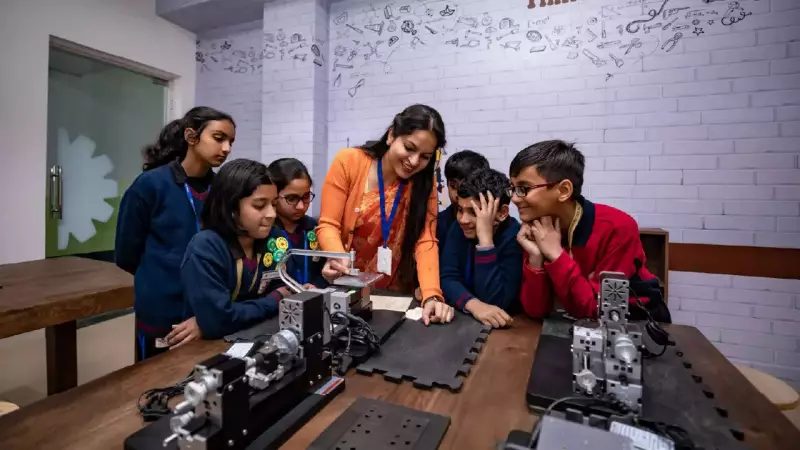
For instance, the school's STEM department runs 'Tinkering Labs,' which embody the core tenet of experiential learning. Beyond academics, Orchids integrates numerous opportunities for collaboration, communication, and personal development. Exposure to varied learning formats and group activities helps students develop cognitive and behavioural flexibility—skills that are paramount in an AI-influenced future defined by constant change.
Preparing for an Unpredictable Future
The rapid pace of technological and societal change makes one thing certain: the future will not follow a single, predictable script. Many of the roles today's children will occupy are still being shaped by innovations yet to emerge. In this context, the most valuable preparation educators and parents can provide is not a fixed set of facts, but the ability to adapt.
An improvement-focused, adaptive mindset equips children to face uncertainty with resilience instead of anxiety. It enables them to stay curious, be receptive to feedback, and trust in their own capacity to grow through change. In the age of artificial intelligence, these intrinsically human capabilities will continue to be the defining factors of meaningful learning and sustained success.