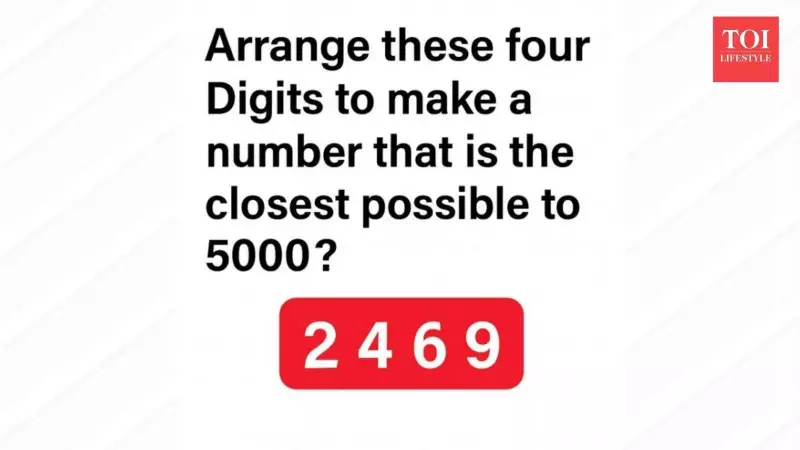
A deceptively simple number puzzle has taken social media by storm, leaving thousands scratching their heads. The challenge, which originated on the platform X (formerly Twitter), asks users to arrange four given digits to form a number as close as possible to 5000.
The Viral Challenge That Stumped Many
User @Matt_Pinner posted the brain teaser, triggering an avalanche of responses. While some commenters claimed to have the answer within seconds, many others admitted to staring at the digits longer than anticipated, their confidence wavering. The rules are clear: use each of the digits 2, 4, 6, and 9 exactly once to create a four-digit number. The goal is singular – achieve the closest possible value to the target of 5000.
On the surface, it seems straightforward. However, the moment one begins mentally shuffling the numbers, doubt sets in. Critical questions emerge: Should the number be just above or just below 5000? Which digit deserves the coveted thousands place? These subtle decisions transform a simple task into a proper test of numerical reasoning.

Breaking Down the Solution
The consensus in the comments, after much debate, converged on one answer: 4962. But is this truly the optimal solution? Let's verify with logic.
Since the available digits do not include a 5 or a 0, forming the exact number 5000 is impossible. Therefore, the closest number must be either slightly less than or slightly greater than 5000. A number starting with 6 or 9 would be in the 6000s or 9000s, placing it far from the target. Thus, the first digit must be 4 to land in the 4000s, the nearest range to 5000.
With 4 fixed in the thousands place, the remaining digits are 2, 6, and 9. To maximize the number and bring it as close to 5000 as possible, the next digits should be placed in descending order. This logic places 9 in the hundreds place, 6 in the tens place, and 2 in the units place, giving us 4962.
Why 4962 is Unbeatable
The proof lies in the simple arithmetic of the gap. The difference between 5000 and 4962 is a mere 38. Consider the alternative arrangement, 4926. The gap here is 74, which is significantly larger. Other combinations like 4692 or 4629 create even wider margins. The math is unequivocal: 4962 is indeed the closest possible number to 5000 using the digits 2, 4, 6, and 9.
This puzzle's viral spread is no accident. Such teasers offer a quick hit of intellectual engagement, demanding precision under a self-imposed time pressure. A single misplaced digit alters the outcome, fueling a competitive instinct as people rush to solve and share their answers first.
While solving these puzzles won't magically bestow "super genius" status, they undoubtedly serve as a sharp exercise for the brain. They enhance number sense, improve mental agility, and reveal how we approach problem-solving under constraints. The ultimate lesson from this viral teaser is clear: sometimes, the smartest move isn't to rush, but to pause, analyze the pattern, and proceed with calculated logic.