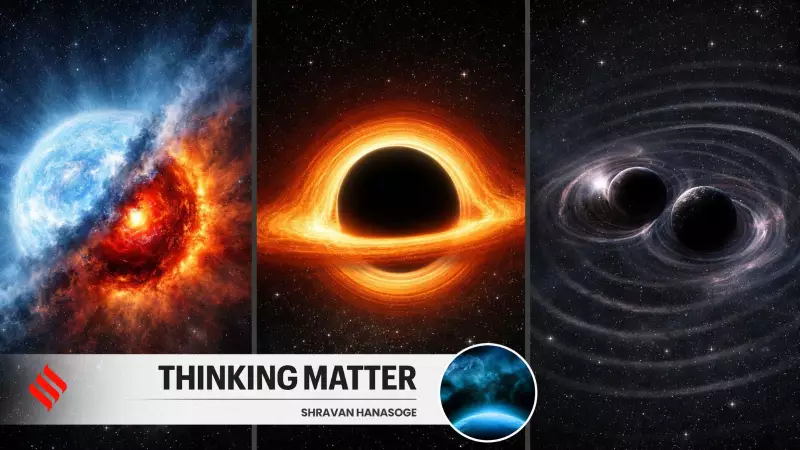
Black holes are often misunderstood as cosmic vacuum cleaners, but they are far more fascinating. They represent regions where gravity becomes so overwhelmingly powerful that nothing, not even light, can escape. This phenomenon occurs when a massive amount of matter is compressed into an incredibly tiny space. The point of no return is marked by the event horizon. From a distance, a black hole behaves like any object of similar mass, but up close, it warps the very fabric of space and time.
The Silent Death of Stars: Stellar-Mass Black Holes
Most known black holes are born from the dramatic deaths of massive stars. Stars shine due to nuclear fusion in their cores, which creates outward pressure to balance gravity's inward pull. When the star's fuel is exhausted, this balance shatters. For the most massive stars, the core collapses under its own immense weight.
This collapse often triggers a cataclysmic supernova explosion, while the core condenses into a black hole merely tens of kilometers across yet containing more mass than our Sun. However, astronomers have made a startling discovery: not all stellar deaths are loud. They have observed "vanishing stars"—massive stars that simply fade from view without a brilliant supernova.

In these cases, the star appears to collapse directly into a black hole, swallowing itself so completely that almost no light escapes. These failed supernovae confirm a long-predicted theory: some stars die in near silence, their demise marked only by gravity's relentless, undramatic triumph.
Monsters in the Middle: Supermassive and Intermediate Black Holes
At the heart of nearly every galaxy, including our Milky Way, lurk supermassive black holes. These behemoths are millions to billions of times heavier than the Sun and anchor their host galaxies. Their presence is inferred by observing stars whirling at incredible speeds around an invisible central point.
A monumental breakthrough came in 2019 when the Event Horizon Telescope collaboration released the first-ever image of a black hole's shadow, located in the galaxy M87. This global network of radio telescopes provided direct visual evidence, confirming Einstein's theories and showing a glowing ring of hot gas encircling a dark void.
Between stellar-mass and supermassive black holes lies another class: intermediate-mass black holes. For years, their existence was speculative, but recent detections of gravitational waves suggest they form through repeated mergers in dense star clusters. Even more mysterious are primordial black holes, hypothetical objects that may have formed in the universe's earliest moments and could be a component of dark matter, though evidence remains elusive.
Listening to the Cosmos: Gravitational Waves and Our Safety
Black holes announce their presence not just through light but through motion. In 2015, scientists made history by detecting gravitational waves—ripples in spacetime—from two black holes spiraling and merging over a billion light-years away. When translated into sound, this cosmic event produced a distinctive "chirp," echoing a collision from the distant past. This discovery opened a new window onto the universe, allowing us to "hear" events invisible to traditional telescopes.
Despite their fearsome reputation, black holes pose no threat to Earth. A black hole with the Sun's mass would behave gravitationally like the Sun unless it replaced it. The danger lies in proximity to the event horizon, not in some mysterious long-range suction.
Black holes are fundamental to our understanding of the cosmos. They shape galaxies, regulate star formation, and provide the most extreme tests for our theories of gravity and spacetime. As Stephen Hawking noted, they challenge our deepest conceptions of reality.

The story of black holes has deep Indian roots. At just 19 years old in 1930, during a ship voyage to England, Subrahmanyan Chandrasekhar performed the pioneering calculations on the fate of collapsing stars. From his solitary work to the silent vanishing of stars today, black holes have evolved from mathematical curiosities to central characters in our cosmic narrative, reminding us of the universe's vast, beautiful, and utterly extreme nature.
This article is based on insights from Dr. Shravan Hanasoge, an astrophysicist at the Tata Institute of Fundamental Research in Mumbai.