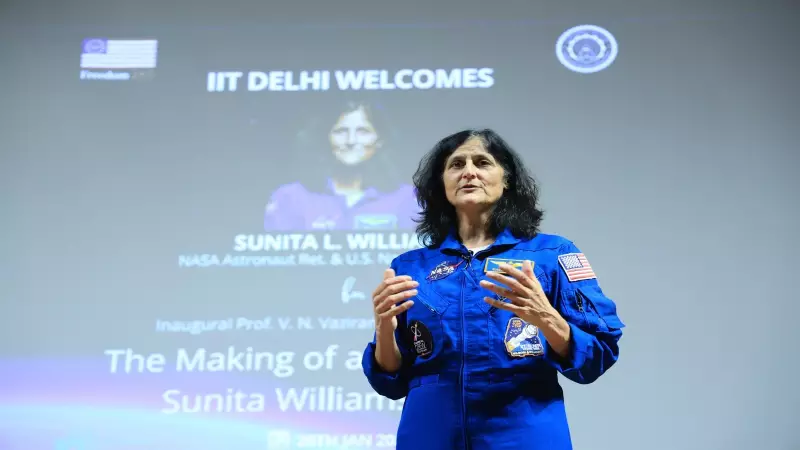
In a captivating address at the prestigious Indian Institute of Technology (IIT) Delhi, NASA astronaut Sunita Williams offered a unique glimpse into the profound lessons learned from life beyond Earth's atmosphere. The event, which drew a large audience of students, faculty, and space enthusiasts, highlighted how the experience of weightlessness in space can fundamentally alter our understanding of both humanity and the universe.
Gravity's Absence as a Catalyst for Self-Discovery
Williams, a veteran of two space missions with over 322 days spent in orbit, emphasized that the removal of gravity's constant pull in the microgravity environment of the International Space Station (ISS) serves as a powerful tool for introspection. She explained that when gravity is taken away, astronauts begin to perceive the world and their place in it from an entirely new vantage point. This shift in perspective, according to Williams, allows for a deeper comprehension of human physiology, psychology, and our interconnectedness with the cosmos.
Insights from Life on the International Space Station
During her talk, Williams shared anecdotes from her time aboard the ISS, illustrating how daily activities in zero gravity—such as eating, sleeping, and conducting experiments—reveal subtle aspects of human nature and adaptability. She noted that the challenges of living in space, including the need for meticulous planning and teamwork, mirror broader human endeavors on Earth, fostering a sense of global unity and cooperation.

The experience of floating freely in space, Williams remarked, "not only changes how you move but also how you think. It makes you realize how much we are shaped by our environment and how adaptable we can be when faced with extraordinary conditions."
Broader Implications for Science and Humanity
Williams' insights extend beyond personal reflection to encompass significant scientific and philosophical implications. She discussed how space exploration, particularly missions involving extended stays in microgravity, contributes to advancements in fields like medicine, engineering, and environmental science. By studying the effects of zero gravity on the human body, researchers can develop new treatments for Earth-based ailments and gain insights into long-term space travel.
Inspiring the Next Generation of Explorers
At IIT Delhi, Williams' message resonated strongly with the student community, many of whom aspire to careers in science, technology, engineering, and mathematics (STEM). She encouraged young minds to pursue their curiosity about the universe, stressing that space exploration is not just about reaching new frontiers but also about understanding our own planet and species better. Her visit aimed to ignite passion for space science and innovation among India's future leaders.
In conclusion, Sunita Williams' lecture at IIT Delhi underscored the transformative power of space travel. By experiencing the absence of gravity, astronauts like Williams gain invaluable insights that enrich our collective knowledge and inspire a deeper appreciation for the mysteries of the universe and the resilience of the human spirit.