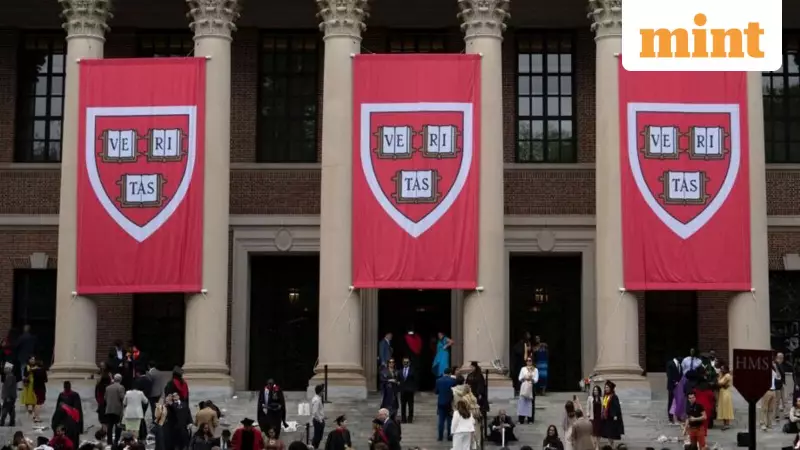
A recent internal investigation at Harvard University has uncovered a troubling academic trend that's raising questions about educational standards across American institutions. The prestigious Ivy League school is facing a serious grade inflation problem that threatens to undermine the value of its degrees.
The Shocking Numbers Behind Harvard's Grade Inflation
The comprehensive 25-page report authored by Dean of Undergraduate Education Amanda Claybaugh reveals startling statistics about Harvard's grading practices. More than 60% of grades awarded to undergraduates during the 2024-25 academic year were A's, representing a dramatic increase from approximately 25% just two decades ago.
The median grade-point average at graduation tells an equally concerning story. While it stood at 3.29 in 1985, it has now climbed to an impressive 3.83. Even more telling is the fact that since 2016, the median GPA at Harvard has consistently been an A, despite students reporting no significant increase in study hours over the past 20 years.

Campus Culture and Faculty Concerns
The report indicates that grade inflation has become an open secret within the Harvard community. Faculty members expressed serious concerns about what they perceive as a clear misalignment between grades awarded and actual student performance quality. According to Dean Claybaugh's findings, nearly all teaching staff acknowledged the problem.
Student behavior appears to have adapted to this lenient grading environment. Many undergraduates are increasingly opting for less demanding courses to free up time for extracurricular activities. The current system effectively makes little distinction between students who have truly mastered course material and those who haven't, creating an educational environment that prioritizes comfort over challenge.
Student Reactions and Mental Health Concerns
Unsurprisingly, Harvard students responded negatively to the report's findings. The Harvard Crimson documented various student perspectives, with one individual describing the revelations as soul-crushing. Some argued that implementing stricter academic standards would threaten student mental health, while others maintained that current grading is already excessively harsh.
One freshman articulated the anxiety many students feel: I can't reach my maximum level of enjoyment just learning the material because I'm so anxious about the midterm, so anxious about the papers, and because I know it's so harshly graded. If that standard is raised even more, it's unrealistic to assume that people will enjoy their classes.
A National Problem Beyond the Ivy League
While Harvard's situation is particularly notable, the problem of grade inflation extends far beyond Cambridge. A 2023 Yale University report found that nearly 80% of grades given to undergraduates were A's or A-minuses. The National Center for Education Statistics confirms this is a nationwide trend, reporting that between 1990 and 2020, median college GPAs rose by 21.5%.
Interestingly, the largest increase of 17% occurred at public four-year institutions rather than Ivy League schools. The pandemic-era lenient grading standards exacerbated the situation, but the trend clearly predates COVID-19.
Broader Implications for Graduate Education
The dilution of academic standards presents equal concerns in graduate programs. Stanley Goldfarb, former associate dean of curriculum at the University of Pennsylvania Medical School, highlighted how competency standards are being compromised in favor of demographic balancing. Medical licensing exams have shifted from numerical scoring to simple pass/fail systems, a change that Goldfarb compares to Major League Baseball eliminating batting averages to ensure that no ethnic cohort outperforms the others.
Potential Solutions and Systemic Challenges
Harvard is considering several proposals to address the grade inflation crisis. One approach would limit the number of A-plus grades awarded in each course, while another would require instructors to include median class grades on student transcripts. However, the report acknowledges these measures would likely have only marginal impact.

The more fundamental issue, according to education analysts, is that colleges are admitting too many students ill-suited for traditional four-year programs. The push for universal college education, combined with tuition subsidies, creates incentives for institutions to lower standards across admissions, grading, and graduation requirements.
A more effective solution might involve privatizing student lending and requiring colleges to assume partial responsibility for defaulted student loans. This approach would give educational institutions more skin in the game and encourage more selective admissions and maintained academic standards.