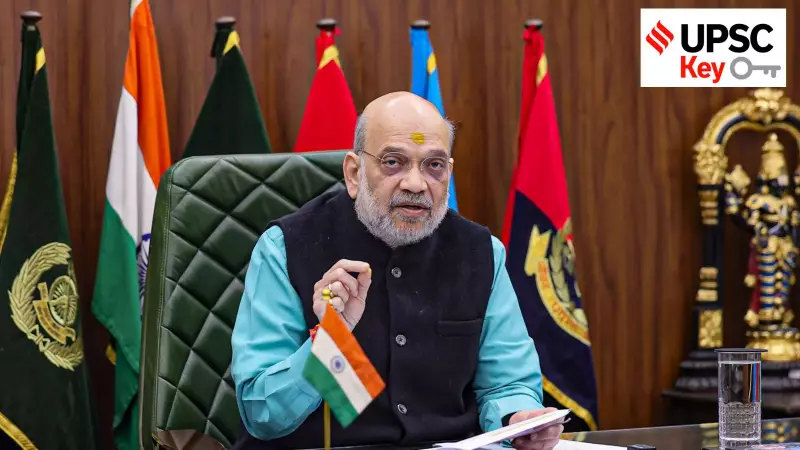
In a significant move to bolster India's counter-terrorism infrastructure, Union Home Minister Amit Shah inaugurated the operationalisation of the National IED Data Management System (NIDMS) on January 10, 2026. This development, alongside critical international developments concerning multilateralism, currency dynamics, and global alliances, forms the crux of the day's essential reading for UPSC aspirants as highlighted in The Indian Express UPSC Key.
National IED Data Management System: A Digital Shield Against Terrorism
Delivered via a video message, Home Minister Shah's inauguration marks the launch of a centralised, secure national platform dedicated to managing data from Improvised Explosive Device (IED) incidents. Developed under the aegis of the National Security Guard (NSG) with pivotal research and academic support from Gujarat's Rashtriya Raksha University (RRU), the NIDMS is designed as a single, authoritative repository for IED-related information nationwide.
The system aims to strengthen prevention, investigation, and response mechanisms by enabling standardised data collection, real-time sharing among authorised agencies, and advanced analysis using AI/ML technologies. It will track the tactics, techniques, and procedures of terror networks, maintain a database of explosive materials and forensic findings, and aid in formulating immediate and long-term countermeasures. The government statement underscored that IEDs have become the weapon of choice for terrorists due to their potential for mass casualties and low detection risk.

India Reaffirms Multilateralism Amid US Withdrawals
In the realm of international relations, India firmly reiterated its commitment to multilateralism following US President Donald Trump's announcement to withdraw from 66 international organisations, including UN bodies and the International Solar Alliance (ISA). Ministry of External Affairs spokesperson Randhir Jaiswal stated that "India stands for multilateralism and believes that global issues need consultative and collaborative action by all countries."
This US move is perceived to create a leadership and funding vacuum in global institutions, potentially opening doors for other powers like China to increase their influence. For the ISA—a India-France initiative headquartered in Gurugram aimed at mobilising $1 trillion for solar projects by 2030—the US exit poses financial and diplomatic challenges, though the alliance has diversified its membership since inception.
Rupee Depreciation: A Calculated Approach by RBI
The editorial page featured a debate on the Indian rupee's management. Contrary to suggestions that the Reserve Bank of India (RBI) should allow the rupee to depreciate freely to find its "fair value" based on trade and capital flows, an argument was made for a gradual and strategic approach. A sudden, sharp depreciation could lead to overshooting, trigger inflation via terms of trade shocks, and adversely impact corporate balance sheets with lower hedging volumes.
The RBI's current strategy is seen as an optimisation exercise: gradually guiding the currency while minimising economic shocks, using foreign exchange reserves to smooth volatility, and eventually building inherent market stability. This involves managing the complex interplay between the Nominal Effective Exchange Rate (NEER) and the Real Effective Exchange Rate (REER).
NATO's Collective Might Masks Stark Internal Disparities
Global geopolitics provided a lesson in alliance structures through the lens of NATO. While NATO remains the world's most potent military alliance, a deep analysis reveals wide economic and military disparities among its 32 members, with the United States standing as a colossus. In 2025, the US economy's GDP surpassed the combined total of all other NATO members—a reversal from a decade ago.

This imbalance extends to defence spending, where the US outspends the rest combined, allocating a much higher percentage of its GDP. This internal power dynamic becomes crucial in understanding the alliance's cohesion and decision-making, especially in light of hypothetical crises such as a US attempt to acquire Greenland, a territory of NATO member Denmark.
Potential US Sanctions Bill Threatens Indian Exports
In economic diplomacy, a proposed "Russia sanctions Bill" in the US, reportedly approved by President Trump, poses a significant threat to Indian exports. The bill proposes 500% tariffs on all goods and services from countries that "knowingly engage" in the exchange of Russian-origin uranium and petroleum products.
Given India's continued import of Russian oil and the absence of a bilateral trade deal with the US, the passage of this bill could be devastating. It threatens India's exports worth over $85 billion, particularly impacting labour-intensive sectors like textiles and footwear, and could weaken India's position in ongoing trade negotiations with other blocs like the European Union and ASEAN.
Cultural Repatriation: The Homecoming of Piprahwa Gems
In a win for cultural heritage, precious gemstones from the 1898 Piprahwa excavation, associated with the relics of the Buddha, were successfully repatriated to India from Hong Kong in July 2025. These artifacts, discovered in Uttar Pradesh near the India-Nepal border, had been put up for auction by Sotheby's. Following legal notices from the Indian government and a unique public-private partnership with industrialist Pirojsha Godrej, the relics were brought back and are now displayed in Delhi, highlighting the importance of protecting national antiquities.
Other Key Developments: The DRDO achieved a milestone in hypersonic technology with a 12-minute test of its Scramjet Combustor. Parliament's Budget Session was scheduled from January 28 to April 2, 2026. Protests in Iran over economic woes turned anti-regime, drawing comments from the US. Experts emphasised that implementing the National Education Policy requires trust between the state and institutions for building a high-quality education system.