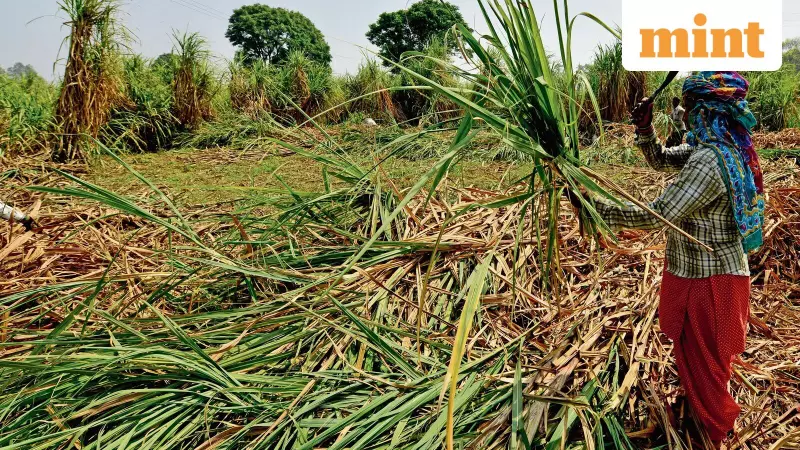
A significant shift is underway in the sugarcane fields of western Uttar Pradesh, where farmers are increasingly choosing to sell their harvest across the state border in Haryana. This movement is driven by a straightforward economic incentive: a higher price offered by Haryana's sugar mills.
The ₹15 Per Quintal Pull Factor
The core of the issue lies in the difference in the State Advised Price (SAP), the minimum price mills must pay farmers. For the 2025–26 crushing season, Uttar Pradesh has set its SAP for early-maturing cane varieties at ₹400 per quintal. In contrast, neighbouring Haryana has raised its SAP to ₹415 per quintal for similar varieties, creating a clear ₹15 per quintal advantage.
"The difference of ₹15 per quintal is enough to influence a farmer's decision, especially when input costs have surged," explained Ranbir Singh, a sugarcane farmer and president of the Saharanpur-based Kisan Nyay Morcha. He noted, however, that this cross-border sale is primarily viable for farmers whose fields lie within a 20-kilometre radius of Haryana's mills.

Border Districts at the Centre of the Shift
The trend is most pronounced in western Uttar Pradesh districts that share a border with Haryana, including Saharanpur, Shamli, Baghpat, and Muzaffarnagar. The geographical proximity makes transportation feasible. Farmers cite not only the higher price but also Haryana's reputation for a faster payment mechanism as key incentives.
"Farmers are inclined towards lucrative returns, especially when input costs have surged. Haryana's faster payment mechanism is an additional incentive," stated an anonymous source familiar with the development. Another farmer from Saharanpur's Gangoh tehsil, Ravi Singh, confirmed that border village cultivators have historically sold produce based on which state offers a better SAP.
Official Vigilance and Policy Challenges
The Uttar Pradesh government has acknowledged the issue and is monitoring the situation. A senior official from the state's Sugar Industry and Cane Development Department stated, "We are keeping a vigil so that the farmers do not sell their crop in Haryana." The official added that efforts are being made to ensure timely payments by UP mills to discourage farmers from looking elsewhere.
Officially, the system is designed to prevent such movement. The India's Sugarcane (Control) Order, 1966 demarcates specific cultivation areas for each mill. Deepak Ballani, director general of the Indian Sugar Mills Association (ISMA), emphasized this structured reservation system, stating it leaves "minimal scope for any cross-border movement of cane on legal grounds." Officials at Haryana mills also deny actively procuring from UP farmers, though one admitted the practical difficulty of stopping sales if farmers mix their produce with that of relatives across the border.
Broader Implications for Sugar Sector Policy
Experts believe this development highlights a deeper structural issue in India's sugar sector. Farm expert and former member of the Uttar Pradesh Planning Commission, Sudhir Panwar, pointed out, "Unless Uttar Pradesh revises its SAP or strengthens its payment system, the diversion trend may continue." The situation underscores the need for greater price harmonisation across states and a review of the SAP mechanism to ensure a level playing field for mills while protecting farmer incomes.
The trend emerges even as sugarcane production in India is on an upward trajectory. According to the Union agriculture ministry's first advance estimates for 2025-26, national cane production is projected to reach 4,756.14 lakh tonnes. In Uttar Pradesh, the cane area has slightly declined this season to 22.57 lakh hectares, but sugar output is estimated to rise to 103.2 lakh tonnes. In Haryana, the area under cane is around 72,000 hectares.

Concurrently, the National Federation of Cooperative Sugar Factories Ltd. (NFCSF) has urged the central government to raise the Minimum Selling Price (MSP) of sugar from the long-stagnant ₹31 per kg to ₹41 per kg. This demand is based on rising production costs and declining ex-mill sugar prices, which are creating financial stress for mills and affecting their ability to pay farmers promptly. While the government's permission for 15 lakh tonnes of sugar exports for 2025–26 has been welcomed, the NFCSF cautions that more support is needed to address the sector's liquidity crisis.