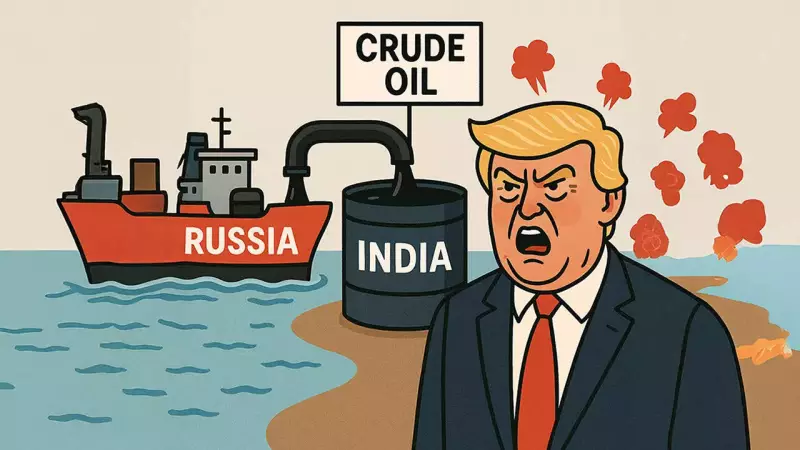
India's purchases of Russian crude oil are demonstrating remarkable strength in December, undeterred by recent sanctions imposed by former US President Donald Trump on major Russian energy firms. Contrary to expectations of a sharp decline, trade data indicates imports may even increase, underscoring the resilience of the India-Russia energy partnership amidst Western pressure.
Sanctions Fail to Dent Import Volumes
Despite the activation of Trump's sanctions targeting Russian oil giants Lukoil and Rosneft, early trade flow data for December suggests India's imports are on track to surpass 1.2 million barrels per day (bpd). This comes after the country received a substantial 1.77 million bpd in November, marking a 3.4% rise from October. Industry sources suggest the December average could reach as high as 1.5 million bpd by month-end.
The initial surge is partly attributed to buyers rushing to finalise deals before a Washington deadline on November 21 for transactions involving the sanctioned companies. Shipments arranged before this cutoff have been arriving at Indian ports, as confirmed by LSEG data.

Deep Discounts and New Suppliers Sustain Flow
A key driver for continued Indian purchases is the attractive pricing offered by Russian crude. For January loadings, Indian refiners are securing discounts of approximately $6 per barrel against the dated Brent benchmark. This discount is notably two to three times larger than what was available in August, making the oil economically compelling.
Critically, the trade is being sustained through non-sanctioned entities that have stepped in to supply Russian cargoes. According to trade sources, this shift is expected to maintain import volumes in January close to December levels, despite the sanctions on specific companies.
Refiner Strategies: A Mixed Picture
The response from individual Indian refiners varies significantly:
- Indian Oil Corp (IOC), the country's largest refiner, has maintained its Russian oil purchases at pre-sanctions levels.
- Bharat Petroleum (BPCL) has increased its acquisitions for January to at least six cargoes, up from two in December.
- Hindustan Petroleum (HPCL) is actively negotiating January loadings.
- Nayara Energy, which is majority-owned by Russian entities including Rosneft, continues to buy Russian oil exclusively after other suppliers withdrew due to separate EU and UK sanctions.
However, some refiners have stepped back. Reliance Industries has reportedly stopped new purchases, though it is receiving pre-arranged cargoes this month. Similarly, HPCL Mittal Energy and Mangalore Refinery and Petrochemicals are not procuring Russian oil for January.
Broader Trade Dynamics and US Pressure
India became Russia's top seaborne crude buyer after Western nations imposed sanctions on Moscow following its invasion of Ukraine. This flourishing trade, however, has introduced friction in India's negotiations with the United States. President Trump recently raised import tariffs on certain Indian products to 50%, a move seen by analysts as partly linked to broader trade and geopolitical disagreements.
A US official framed the sanctions as successful in forcing Russia to offer deep discounts and reducing its pool of buyers, thereby limiting Kremlin revenues for its war effort. Meanwhile, Russian producers are employing domestic market swaps—a standard practice—to keep oil flowing to India. This involves exchanging oil meant for local Russian refineries with export volumes handled by companies not under sanctions.
Prashant Vashisth, Vice President at Moody's affiliate ICRA, explained the mechanism: "There is a possibility that non-sanctioned entities can increase their crude output and shift supplies to export markets, and sanctioned barrels can meet Russia's local demand." This logistical reshuffling ensures that the vital energy trade between New Delhi and Moscow adapts and endures.