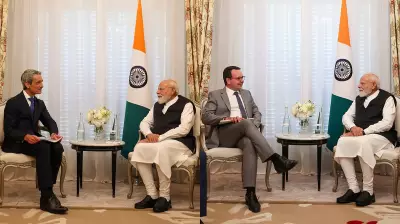
In a significant move to deepen its economic footprint in the Gulf region, India has signed a Comprehensive Economic Partnership Agreement (CEPA) with the Sultanate of Oman. The pact was inked on Thursday during Prime Minister Narendra Modi's two-day official visit to Muscat, marking a strategic milestone in bilateral relations.
A Strategic Pillar Beyond Trade Volume
The agreement, finalized after negotiations that began in November 2023, covers goods, services, and investments. It is expected to become operational within a few months after completing domestic legal procedures in both nations. The signing ceremony was attended by PM Modi and Oman's head of state, along with senior officials.
While the immediate boost to trade figures might be measured, experts emphasize the deal's profound strategic value. Dattesh Parulekar, an assistant professor of international relations at Goa University, notes that the FTA's real worth lies in strengthening India's energy security, investment presence, and regulatory access in the Gulf, rather than just chasing export numbers.

This is the sixth such trade pact signed under the current NDA government and the first under Commerce Secretary Rajesh Agarwal's tenure. It follows agreements with Mauritius, the UAE, Australia, the European Free Trade Association (EFTA), and the UK.
Analyzing the Trade Dynamics and Opportunities
Bilateral trade between India and Oman was valued at approximately $10.5 billion in the 2024-25 financial year. India's exports to Oman, worth $4.1 billion, include petroleum products, machinery, aircraft, rice, and iron and steel. Imports from Oman, at $6.6 billion, are dominated by crucial items like crude oil, liquefied natural gas (LNG), and fertilizers.
According to a report by the Global Trade Research Initiative (GTRI), the CEPA broadly follows the template of India's pact with the UAE. Although over 80% of Indian goods already enter Oman at low tariffs, the agreement will eliminate duties on many products, improving competitiveness. However, with Oman's population of around five million and a GDP of about $115 billion, the scope for massive export growth is inherently limited.
Ajay Srivastava, founder of GTRI, stated that the pact is more about anchoring India's long-term economic and strategic presence in the Gulf. It aims to reinforce supply chains, reduce regulatory friction, and deepen investment ties with a key energy partner.
Regulatory Gains and Long-Term Strategic Depth
Beyond tariffs, India is set to gain significant regulatory advantages, particularly for its pharmaceutical sector. The CEPA may include provisions to fast-track approvals for Indian drugs that have already been cleared by stringent regulators like the US FDA, UK's MHRA, and the European Medicines Agency.
The strategic dimension of the agreement is substantial. Indian investments in Oman already exceed $7.5 billion, spread across more than 6,000 joint ventures, many in free zones like Sohar and Salalah. The CEPA is expected to solidify this investment footprint and enhance India's geopolitical positioning in a critically important region.
As India continues its trade push with other major partners like the European Union and the United States, the Oman CEPA stands out as a calculated move to build resilient economic bridges in the Gulf, ensuring energy security and creating a stable platform for Indian businesses beyond mere trade statistics.