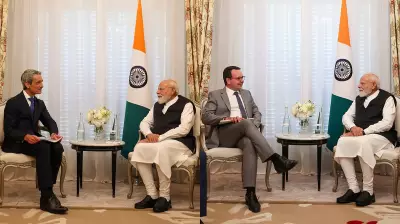
In a significant development for bilateral economic ties, Prime Minister Narendra Modi and his New Zealand counterpart Christopher Luxon on Monday announced the finalisation of the India-New Zealand Free Trade Agreement (FTA). The announcement came following a telephonic conversation between the two leaders, who underscored the pact's potential to dramatically enhance trade, investment, and innovation between the two nations.
A Deal Years in the Making: Key Economic Pillars
The negotiations for this comprehensive trade deal were formally launched during Prime Minister Luxon's visit to India in March 2025. Both governments have positioned the agreement as a cornerstone for future economic engagement, aiming to improve market access, encourage two-way investment, and strengthen strategic cooperation across sectors.
A major win for India is the provision of zero-duty access for Indian exports to New Zealand across all tariff lines once the FTA is implemented. This is expected to provide a substantial boost to labour-intensive sectors such as textiles, apparel, leather, and footwear, benefiting farmers, MSMEs, workers, and women-led enterprises.

Furthermore, New Zealand has committed to investing $20 billion in India over a 15-year period, following a model akin to the European Free Trade Association framework. These investments are slated to target manufacturing, infrastructure, services, innovation, and job creation, providing a significant fillip to India's investment landscape.
Services, Mobility, and Protecting Sensitive Sectors
The agreement breaks new ground in services and mobility. New Zealand has offered market access in 118 services sectors and extended Most Favoured Nation (MFN) treatment in 139 sectors. India has reciprocated with access in 106 service sectors and MFN status in 45. Notably, the pact includes a first-of-its-kind annex on health and traditional medicine services for New Zealand.
Mobility provisions are a landmark feature. For the first time, New Zealand has signed an Annex on Student Mobility and Post-Study Work Visas with another country. This arrangement places no numerical caps and guarantees Indian students the right to work 20 hours per week. Post-study work visas have been secured for up to three years for STEM bachelor's and master's graduates, and up to four years for PhD holders.
The deal also creates a new Temporary Employment Entry Visa pathway, allowing up to 5,000 Indian professionals in skilled occupations like IT, engineering, healthcare, AYUSH, yoga, and Indian culinary arts to work in New Zealand for up to three years. An additional Working Holiday Visa scheme will permit 1,000 young Indians to travel to New Zealand annually.
On the goods front, India's average MFN tariff will see a phased reduction. Importantly, India has protected sensitive domestic sectors. Products including dairy, sugar, certain edible oils, precious metals, and select agricultural items have been shielded from tariff concessions to safeguard farmers and domestic industries.
Projected Impact and Leadership Perspectives
Prime Minister Christopher Luxon, in a post on X, highlighted the FTA's benefits for New Zealand, forecasting that NZ exports to India could increase by $1.1 billion to $1.3 billion annually over the next two decades. "Boosting trade means more Kiwi jobs, higher wages and more opportunities," he stated, emphasizing access to India's 1.4-billion-consumer market.
The agreement is projected to create fresh opportunities for innovators, entrepreneurs, and students across a wide spectrum. Indian farmers are expected to gain better access for fruits, vegetables, coffee, spices, and processed foods, supported by initiatives like the Agricultural Productivity Partnership and access to New Zealand's advanced farming technologies.
Bilateral trade figures set the stage for this expansion. In FY 2024-25, merchandise trade between the two countries stood at $1.3 billion, while total goods and services trade approximated $2.4 billion in 2024, with services alone accounting for $1.24 billion. The new FTA aims to double bilateral trade over the next five years, marking a new chapter in India-New Zealand economic relations.