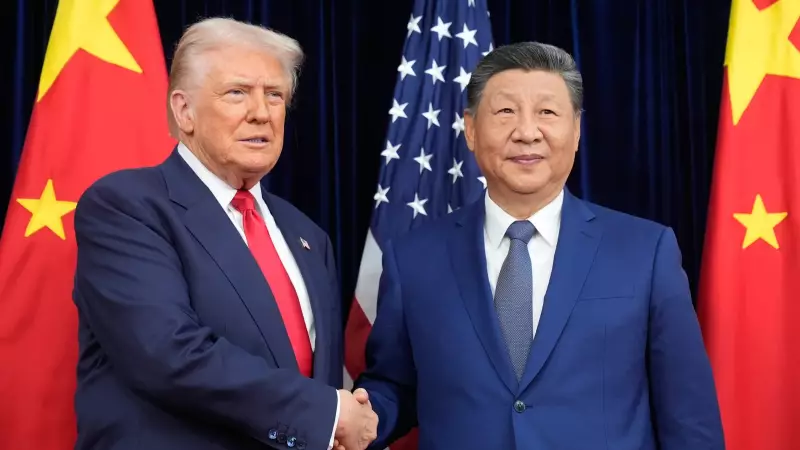
Trump's Tariff Strategy Fails to Curb China's Trade Dominance
Former US President Donald Trump launched aggressive tariffs with one clear goal. He wanted to hurt China's economy and reduce its trade advantage. The results tell a different story. China has just posted a record annual trade surplus, smashing through the $1 trillion mark for the very first time.
A Staggering $1.19 Trillion Surplus
New data for 2025 reveals China's trade surplus hit an astonishing $1.19 trillion. This figure easily surpasses the previous year's $980 billion. The achievement is remarkable. It comes despite intense global scrutiny and pushback against China's industrial overcapacity.
Many analysts find the result impressive but not entirely surprising. Four powerful factors explain China's continued trade strength.

1. Resilient Global Trade and Supply Chain Shifts
Global trade proved surprisingly resilient in 2025. A trend towards protectionism and the weaponisation of trade did not stop its growth. The UN Trade and Development's Global Trade Update projected global trade would exceed $35 trillion for the first time. This represents a 7 percent annual increase.
Trade in goods expanded by $1.5 trillion. Services trade grew by $750 billion, a nearly 9 percent year-on-year rise. Strong demand for AI-related goods and front-loading of shipments ahead of expected tariff hikes fueled this growth.
China sits at the heart of global supply chains. It remains the world's largest exporting nation. A surge in its total exports was almost inevitable under these conditions.
US tariffs did impact Chinese exports to America. However, China found new markets to compensate for these losses. Exports to ASEAN nations jumped by 13.4 percent. Shipments to the European Union grew by 8.4 percent. Exports to Africa soared by 25.8 percent.
Other key markets also showed strong growth. Australia saw a 7.8 percent increase. India received 12.8 percent more Chinese goods. The United Kingdom's imports from China rose by 7.8 percent.
More importantly, Chinese goods often reached American consumers through indirect routes. Vietnam and Mexico became crucial transit points. China's exports to Vietnam witnessed a massive 22.4 percent uptick. Shipments from Vietnam to the US increased correspondingly.
Chinese enterprises also used Mexico for transhipment. They incorporated Chinese products into North American supply chains. Increased Chinese investment in the region further facilitated this trade rerouting.
2. Trump's Tariffs Undermined Global Consensus
Donald Trump's tariff war targeted America's allies, partners, and rivals alike. This move jeopardised a fragile global consensus. Nations were beginning to coordinate a response to counter China's industrial overcapacity.
The United States was central to any potential coordinated action. Once American policies started hitting partners and allies, their calculus changed. It made little sense for these countries to anger China while also facing US tariffs.
Being at loggerheads with the world's two largest economies simultaneously is not a prudent choice. This reality forced a reconsideration of measures by key actors like India and the European Union.
3. China's Unmatched Manufacturing Might
China continues to operate as the world's largest factory. It maintains a deep presence in both low-end and high-end manufacturing sectors. Currently, China accounts for roughly 30 percent of global manufacturing output by value and volume.
Replacing Chinese supplies is an extraordinarily difficult task. Global de-risking efforts have not yet made a significant impact. Such measures represent a long-drawn process. Beijing appears fully committed to thwarting and delaying these efforts.
4. Domestic Economic Policies Fuel the Surplus
China's burgeoning trade surplus stems directly from its domestic economic policies. Several factors are at play here.
The Chinese Renminbi (RMB) strengthened 4.4 percent against the US dollar in 2025. Despite this, analysts estimate the currency remains undervalued by as much as 25 percent in real terms. The 2025 data masks an important detail. The RMB depreciated in real terms against major trading currencies.

This weakening is evident in the decline of the Real Effective Exchange Rate (REER). The impact is clear in China's trade with the EU. A sharp depreciation of the RMB against the Euro significantly boosted exports to the European bloc.
An expansive domestic industrial policy, fueled by massive state subsidies, further aided China's exports in 2025. The country's solar, electric vehicle, and battery sectors thrived on state support. These industries recorded enormous surpluses.
Deflationary pressures created a race to the bottom in price wars among Chinese companies. This drove down market prices for Chinese goods in external markets. Overall exports increased even as industrial profits within China declined. The Chinese leadership's emphasis on tackling involution-style competition acknowledges this challenging situation.
Finally, China's domestic consumption has not picked up as expected. In 2025, consumption witnessed only modest expansion. It trailed overall economic growth. This means China's imports are not increasing in line with its GDP.
A significant portion of its industrial output is being dumped in external markets. While exports to major trading partners expanded, imports declined sharply from several key regions. Imports from the EU fell by 0.4 percent. ASEAN imports dropped by 1.6 percent. Australia saw a 7.5 percent decline. The UK reduced imports by 4.7 percent, and Canada by 10.4 percent.
The data presents a clear picture. Trump's tariffs failed to achieve their primary objective. China's trade machine adapted, diversified, and grew stronger. The global trade landscape now bears the marks of this miscalculation.