

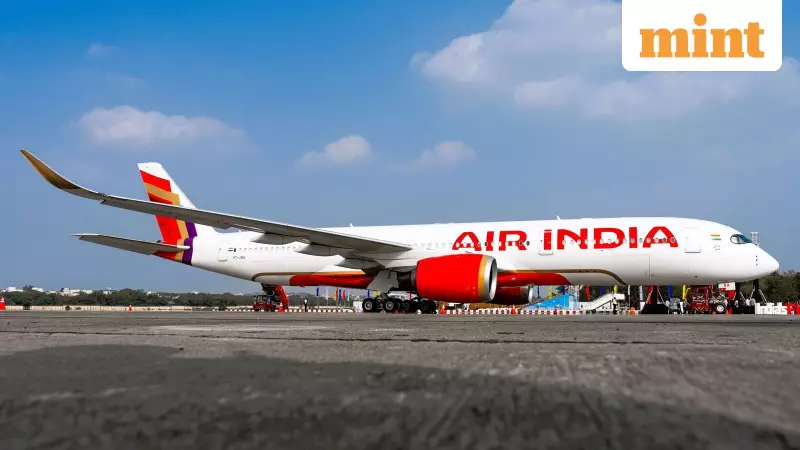
Air India is urgently seeking the Indian government's diplomatic intervention to secure access to sensitive Chinese military airspace in Xinjiang, as the financial impact of Pakistan's airspace ban on Indian carriers continues to mount dramatically. This unprecedented request comes just weeks after direct India-China flights resumed following a five-year hiatus caused by Himalayan border tensions.
Financial Strain Mounts for National Carrier
According to internal documents reviewed by Reuters, Air India is facing severe operational and financial challenges due to Pakistan's airspace closure that began in late April amid diplomatic tensions. The country's only carrier with a major international network has seen fuel costs surge by up to 29% on some long-haul routes, with journey times increasing by as much as three hours.
The previously unreported document submitted to Indian officials in late October reveals that Air India estimates the Pakistan airspace closure's impact on its pre-tax profit at $455 million annually. This represents a massive blow for the airline, which reported a fiscal 2024-25 loss of $439 million.

Strategic Alternative Through Chinese Airspace
Air India has specifically requested the Indian government to diplomatically approach China for alternative routing and emergency access to airports in Hotan, Kashgar, and Urumqi in Xinjiang. This strategic move aims to enable faster routes to the United States, Canada, and Europe.
Securing the Hotan route will be a strategic option for the Tata Group and Singapore Airlines-owned carrier, which stated in the document that its long-haul network is under severe operational and financial strain. The airline believes the requested Chinese airspace access could substantially reduce extra fuel requirements and flight times.
Operational Challenges and Safety Concerns
The Chinese airspace Air India seeks to access presents significant challenges. The region is surrounded by some of the world's highest mountains exceeding 20,000 feet and falls within the People's Liberation Army's Western Theater Command. Military analysts note this command is equipped with extensive missile, drone, and air-defense assets and shares some airports with civilian aircraft.
More critically, the Pentagon's December report on China's military indicated that the Western Theater Command's responsibilities include responding to any conflict with India. Open-source intelligence tracker Damien Symon revealed that China's military has recently expanded an airbase at Hotan, further complicating access possibilities.
Data from AirNav Radar shows that no non-Chinese airlines have departed or arrived at Hotan airport in the past 12 months. Aviation consultant Shukor Yusof of Endau Analytics expressed skepticism about China granting access, citing the region's difficult terrain, lack of emergency airports, and potential security concerns.
Route Viability Crisis and Passenger Shift
The Pakistan airspace closure has forced Air India to suspend its Delhi-Washington route in August and reconsider other key routes. According to the document, direct Mumbai and Bengaluru to San Francisco routes are becoming unviable due to an additional three hours of travel time, including technical stops in Kolkata.
The competitive disadvantage has become starkly evident. A flight from San Francisco to Mumbai on Lufthansa via Munich is now only five minutes longer than on Air India. The document explicitly states that passengers are shifting to foreign carriers due to shorter flight times, as competitors benefit from Pakistan overflight permissions.
Air India estimates that accessing the Hotan route in China could help restore passenger and cargo capacity trimmed by up to 15% on routes like New York- and Vancouver-Delhi, while reducing losses by approximately $1.13 million per week.
Broader Financial Implications and Government Support
With no signs of the Pakistan airspace ban easing, Air India has also requested temporary subsidies until normal operations resume. The airline, which has placed $70 billion worth of aircraft orders, is simultaneously seeking government help in resolving legacy tax issues.

Despite government indemnification against claims payable before its sale to Tata in 2022, Air India has received several notices related to old tax liabilities totaling $725 million. A confidential government notice from March revealed that tax authorities warned of coercive steps, including asset freezing, to recover dues of $58 million in one particular case.
The airline stated that contesting these tax demands has created an additional cashflow burden, despite assurances provided during the disinvestment process. This combination of operational challenges and financial pressures represents one of the most significant tests for Air India since its acquisition by the Tata Group.





