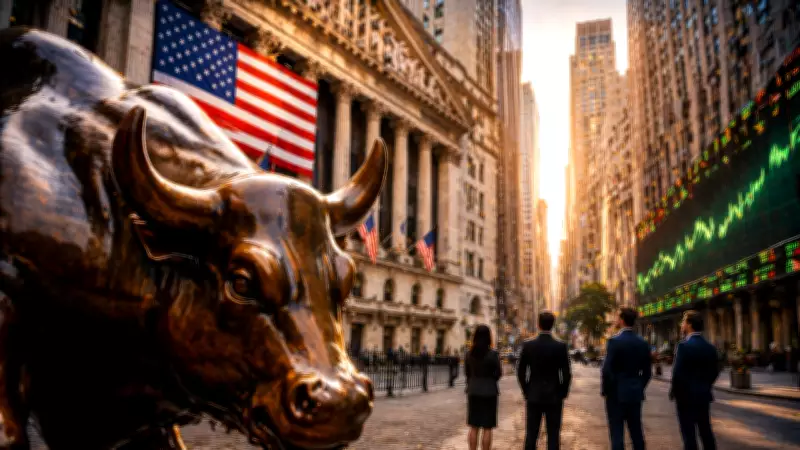
Wall Street Achieves Record Highs Amid Easing Geopolitical Tensions
Wall Street benchmarks soared to record highs on Friday, fueled by a significant reduction in geopolitical tensions in West Asia. This development triggered a widespread risk rally across global markets, propelling equities upward and driving oil prices lower. The optimistic sentiment stemmed from signals that the United States and Iran might avoid a worst-case economic fallout from the ongoing conflict, bolstering investor confidence.
Major Indices Post Strong Gains
The S&P 500 rose by 1.2%, reaching a fresh all-time high and marking its third consecutive record close. This performance also capped its longest weekly winning streak since late October. Similarly, the Nasdaq Composite gained 1.5%, logging its third straight record finish. The Dow Jones Industrial Average surged as much as 1,100 points during the trading session before trimming gains to close up 868 points, or 1.8%, achieving its strongest finish since late February.
Gains were broad-based across the market, with small-cap stocks leading the charge. The Russell 2000 index outperformed large caps, ending at a record high. This outperformance was largely attributed to cooling energy prices, which lifted margin-sensitive smaller companies. Since bottoming out in late March, the broader US market has climbed more than 12%, driven by growing expectations of a de-escalation in West Asia.

Geopolitical Developments Drive Market Optimism
The rally was underpinned by key geopolitical developments. Iran signaled the reopening of the Strait of Hormuz during a temporary ceasefire, a vital conduit for global crude flows. Assurances of uninterrupted passage eased fears of supply disruption, contributing to a sharp fall in oil prices. US President Donald Trump added to the optimism, stating that the war "should be ending pretty soon" and expressing expectations to reach a deal with Iran, including on recovering enriched uranium—a key sticking point in negotiations.
However, it is important to note that after US markets closed, Iran's Parliament Speaker claimed the Strait of Hormuz is not open, introducing a note of uncertainty. Despite this, the initial positive news had already fueled the day's rally.
Oil Prices and Sectoral Movements
Oil markets reacted swiftly to the easing tensions. Brent crude fell by 9% to settle at $90.38 per barrel after hitting a session low of $86.09, while West Texas Intermediate dropped 11.45% to $83.85. Although prices remain above pre-war levels near $70, they have retreated significantly from late-March highs close to $120.
Sectoral moves reflected this shift. Energy majors such as Exxon Mobil and Chevron declined due to lower oil prices, while airlines including American Airlines and United Airlines surged on expectations of reduced fuel costs. Nick Johnson, as quoted by Reuters, explained, "Energy prices coming down has a bigger impact on small caps because they have tighter margins," adding, "it's starting to become clear that the US and Iran want to see this behind them."
Bond Markets and Currency Movements
Bond markets also rallied as inflation concerns eased alongside declining energy prices. US Treasury yields fell, with the benchmark 10-year yield touching its lowest level since mid-March. The 2-year yield, sensitive to Federal Reserve policy expectations, also moved lower. Tom di Galoma commented, "The oil price drop was driving the whole move," though he noted uncertainties about a prolonged ceasefire and strait reopening.
The US dollar weakened to multi-week lows as investors unwound safe-haven positions. George Vessey stated, "The dollar's weakness is mainly about the market unwinding the geopolitical risk premium." In Europe, traders pared expectations of aggressive rate hikes from the European Central Bank and the Bank of England, supporting sovereign bond markets across the region.
Individual Stock Performance
Among individual stocks, Netflix fell more than 9% after issuing a weak growth forecast and announcing the departure of chairman and co-founder Reed Hastings. This decline contrasted with the broader market rally, highlighting company-specific factors at play.

Overall, the record highs on Wall Street underscore how geopolitical developments can swiftly influence global financial markets, driving risk appetite and reshaping investor strategies in response to changing economic conditions.