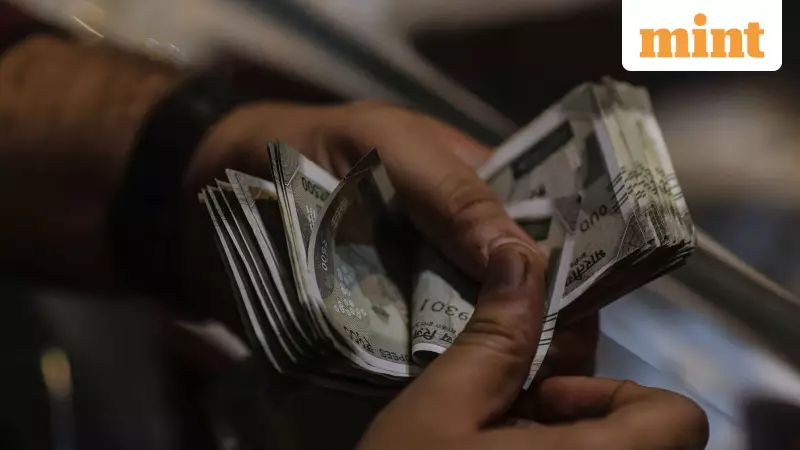
The Indian rupee plunged to a historic low of 89.41 against the US dollar during Friday's trading session, sending shockwaves through financial markets and raising concerns about further depreciation in the coming weeks.
Perfect Storm Drives Rupee to Record Lows
Market participants identified multiple factors behind the sharp decline. The Reserve Bank of India's absence from currency markets after weeks of defending the 88.8-89 range created a vacuum that accelerated the fall. Cascading stop-loss triggers and persistent dollar demand from importers compounded the pressure.
Adding to the negative sentiment were growing uncertainties around the delayed India-US trade deal and comments from RBI Governor that the rupee has no specific target, acknowledging that its weakness reflects global dollar strength and geopolitical tensions.

The currency's sharp drop occurred despite mixed US labor market data that softened US 10-year Treasury yields from 4.15% to below 4.05%, reducing hopes of another Federal Reserve rate cut to about 40%.
Structural Weaknesses Behind Depreciation Trend
Since April, the Indian rupee has depreciated 4.4% against the US dollar, defying both strong domestic economic fundamentals and a generally weaker global dollar.
Gaura Sengupta, chief economist at IDFC First Bank, emphasized that the depreciation story is far from over. Despite a relatively contained current account deficit of 1.3% of GDP, India continues to struggle with weak capital flows.
Foreign portfolio investors have remained cautious toward Indian markets while showing interest in other emerging economies. According to NSDL data, foreign investors have withdrawn $16.4 billion from Indian equities so far in 2025, a stark contrast to the net inflow of $124 million recorded in 2024.
RBI's Diminished Firepower Complicates Defence
The central bank's ability to defend the rupee has become increasingly constrained. The RBI entered the current financial year with a large net short forward book, reducing its flexibility to sterilize spot-market interventions without tightening rupee liquidity.
Heavy dollar selling in October drained approximately ₹1.5 trillion worth of rupee liquidity from the banking system, forcing the central bank to moderate its direct currency defence to avoid choking domestic financial conditions.
A senior dealer at a state-owned bank described the rapid decline: People realized very quickly that there was no RBI at 89.74. Once that level broke, the fall then onwards to 89.50 happened in five minutes.
Market Expectations and Future Trajectory
Despite the current pressures, traders believe the RBI will prevent a disorderly collapse. Ritesh Bhansali, deputy CEO at Mecklai Financial Services, expects the central bank to intervene around the 90.00-90.50 range, preventing a free-fall scenario.
Bhansali anticipates the rupee's near-term range shifting to 88.5-90.5, noting that the currency is now fundamentally undervalued on a real effective exchange rate basis.
Most experts agree that any India-US trade deal would provide only temporary relief. Sengupta predicts such a development might push USD/INR back to 88 or below briefly, but depreciation pressures would resume once the initial euphoria fades.
YES Bank's economics team warns that the balance of payments is now on a knife-edge, with FY26 likely to end with a small deficit. They project the rupee-dollar pair capped at 90 for March if a trade deal materializes, and 89.50-90.00 without one.
Traders expect gradual weakening through the year, with one senior dealer predicting another 50-60 paisa depreciation in the near term, followed by 15-20 paisa each month. Year-end levels near 92 are considered plausible if outflows persist.
Madan Sabnavis, chief economist at Bank of Baroda, highlighted the psychological significance of current levels: If the rupee stays beyond 89 for 2-3 sessions, that becomes the new benchmark.
The consensus remains clear: while a trade deal might offer momentary relief and the RBI can slow the pace of decline, the rupee's broader depreciation trend will continue until capital flows revive substantially.