Gigafactories: India's Strategic Leap in EV Transition Beyond Climate Goals
While the electric vehicle (EV) transition is often framed as a climate story with net-zero commitments, its implications run much deeper, especially for nations heavily reliant on fossil fuel imports. In 2025, research by Ember revealed that electric vehicles displaced a staggering 1.7 million barrels of oil per day globally. Current geopolitical tensions have starkly exposed the vulnerabilities inherent in fossil fuel dependence. For India, which imports nearly 88 percent of its crude oil, the shift to EVs transcends a mere green pledge—it represents a critical strategy for enhancing energy security and economic resilience.
From Scale to Strategy: The Gigafactory Revolution
Tesla's pioneering gigafactory in Nevada set a new benchmark, demonstrating how battery manufacturing plants are now considered matters of national importance. A country that produces batteries at scale not only builds a robust supply chain but also gains significant control over its energy future. With global EV adoption projected to account for 25 percent of all vehicle sales by 2030, the automotive landscape is undergoing a profound transformation.
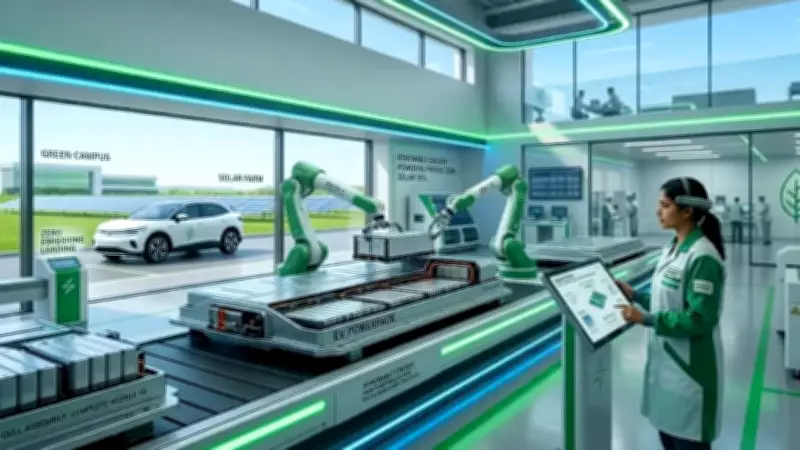
Gigafactories redefine industrial infrastructure by integrating battery manufacturing, component supply, and energy systems into cohesive operations. These facilities, often producing over 30 GWh annually, function as precision chemical plants, high-speed assembly lines, and dynamic data hubs simultaneously. They lower unit costs, accelerate production cycles, and enhance supply reliability, while increasingly connecting to energy grids to store and release power based on demand fluctuations.

The Ecosystem Push: Policy and Collaboration
Gigafactories do not operate in isolation. To achieve full capacity and timely operations, they require synchronized efforts from governments and industries in areas such as permitting, grid access, critical mineral policies, and workforce development. India has laid a strong foundation through initiatives like the Production Linked Incentive (PLI) scheme for advanced chemistry cell batteries, the PM E-drive program, the Atmanirbhar Bharat localization push, and customs duty relief on lithium-ion manufacturing equipment.
What transforms strategic direction into tangible output is a connected ecosystem where battery manufacturers, original equipment manufacturers (OEMs), and engineering and technology partners collaborate seamlessly. No single entity possesses the full spectrum of expertise required for gigafactory success, making unified efforts essential.
The Intelligence Layer: AI and Digital Innovation
Beyond scale, modern gigafactories are distinguished by their intelligence. The real challenge lies not in constructing these plants but in optimizing their yield. Artificial intelligence, data platforms, and connected systems are revolutionizing battery design, production, and optimization.
Digital twins enable manufacturers to simulate processes before physical implementation, reducing commissioning time and boosting operational efficiency. They also tackle a major issue in battery production: waste, where scrap rates can reach 30 percent in early stages, impacting both economics and sustainability.
AI-driven tools, such as computer vision, detect defects in milliseconds, long before products reach final assembly lines. Sensors identify early signs of machine wear, converting potential unplanned shutdowns into scheduled maintenance windows. Predictive maintenance, automated quality checks, and real-time monitoring further enhance productivity. By integrating IT and operational technologies, manufacturers create closed-loop systems where data continuously informs decisions, improving yield, minimizing downtime, and ensuring consistent quality.
Additionally, AI helps manage the substantial energy footprint of gigafactories, which consume power comparable to small cities. Through AI-driven energy management, on-site renewables, and advanced recycling of materials like lithium, cobalt, and nickel, these facilities promote a circular economy while safeguarding critical resources. On the supply chain front, real-time data aids in anticipating disruptions, diversifying procurement, and building input control as a competitive advantage.

People at the Core: Human-Led, Technology-Enabled Environments
Contrary to futuristic narratives that marginalize human roles, gigafactories emphasize human-led, technology-enabled operations. Engineers and operators work alongside AI tools, leveraging data to make faster, more informed decisions. This synergy is fostering demand for a new breed of industrial professionals—individuals adept at understanding both processes and data, managing machines and systems, and solving cross-functional challenges on the factory floor.
The gigafactory of 2030 will require personnel comfortable navigating between physical and digital signals, presenting a dual challenge of training and hiring. As Piyush Goyal, Minister of Commerce and Industry, has emphasized, India must evolve from a technology consumer to a technology creator, with gigafactories serving as a pivotal arena for this transformation.
Strategic Assets for a Resilient Future
The demand for EVs in India is evident, policy directions are clear, and intent is strong. The next critical step involves building intelligent, integrated, and resilient gigafactories to support the EV transition. This endeavor extends beyond merely replacing internal combustion engines with batteries; it is about constructing systems capable of withstanding uncertainties—be they in fuel markets, supply chains, or geopolitics.
Industry estimates suggest India could host 30 to 35 battery gigafactories by 2030. Their role will expand beyond battery production to anchor clean energy ecosystems, generate skilled employment, and reduce exposure to volatile fuel markets. In essence, gigafactories are poised to become strategic assets, driving India toward a more secure and sustainable energy future.
Disclaimer: Views and opinions expressed in this article are solely those of the original author and do not represent any of The Times Group or its employees.