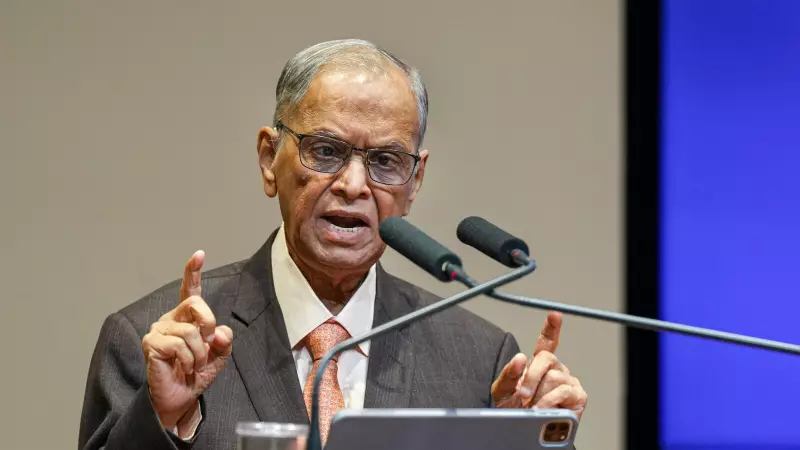
Infosys co-founder Narayana Murthy has reignited a major national conversation about work culture in India by openly endorsing China's controversial 996 work rule. During a recent television interview, the billionaire entrepreneur suggested that Indian workers should adopt this demanding schedule to accelerate the country's development.
What Exactly is the 996 Work Rule?
The 996 work rule refers to an intensive work schedule where employees work from 9 am to 9 pm, six days a week, totaling 72 hours of work weekly. This practice gained notoriety in China's technology sector, where several companies implemented it despite legal restrictions.
Murthy explained the concept during his Republic TV interview with host Arnab Goswami, stating: "There is a saying in China, 9, 9, 6. You know what it means? 9 am to 9 pm, 6 days a week. And that is a 72-hour week."

Murthy's Controversial Stand on Work Culture
The Infosys founder didn't mince words when discussing his vision for India's workforce. When questioned about work-life balance concerns, particularly from younger generations, Murthy responded with a provocative perspective shared by one of his successful corporate friends.
"First we should all get a life then we should worry about work life balance," Murthy quoted, emphasizing his belief that hard work must precede balance. He argued that India's current priority should be hard work, discipline, and smart work to create employment opportunities for those still without jobs.
The veteran entrepreneur elaborated on his philosophy: "I haven't seen anybody in the world who has achieved anything without hard work. Performance leads to recognition, recognition leads to respect, and respect leads to power. If India wants power, it has to perform."
The Global Context and Legal Status of 996
While Murthy presents the 996 model as worthy of emulation, the practice has faced significant opposition in its country of origin. The Chinese Supreme People's Court declared the 12-hour workday system illegal in 2021, following numerous worker tragedies including stress-related suicides and deaths.
Under established Chinese labor law:
- Standard work schedule is eight hours daily for six working days
- Maximum weekly hours cannot exceed 44 hours
- Overtime is limited to 36 hours monthly
- All overtime requires additional compensation
Labor activists and researchers have condemned the 996 system as "modern day slavery," criticizing companies that coercively enforce these demanding conditions despite legal protections for workers.
Murthy's comments come amid ongoing global debates about employee wellbeing, productivity, and sustainable work practices. While he cites Prime Minister Narendra Modi's alleged 100-hour work week as inspiration, the suggestion that India adopt a work model deemed illegal in China continues to generate heated discussion across corporate boardrooms and social media platforms.